Imagine It’s 2 a.m. Your father needs to be admitted, and the billing counter wants ₹50,000 as a deposit. You have cashless health insurance. You even have the card in your wallet. But will it work at this hospital? Nobody at the desk is explaining anything.
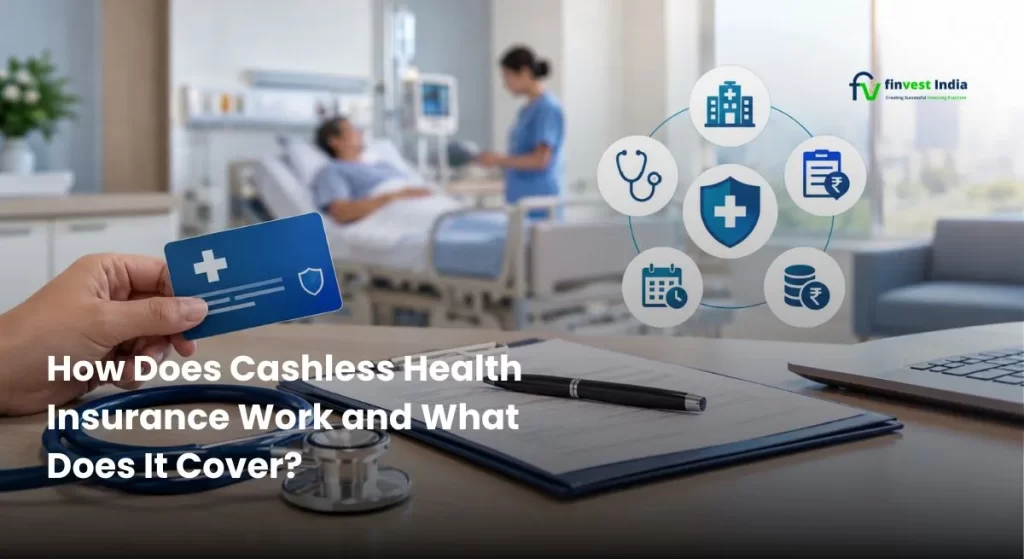
That’s the gap you want to know about before that night. Cashless means the insurer pays the hospital directly for covered treatment. But it doesn’t cover everything, and one missed detail can leave you with a surprise bill.
In this guide, you’ll learn how a cashless claim works step by step, what it covers, what you may still pay, and what to do if it gets stuck. Let’s get you ready before you ever need it.
Quick answer: Cashless health insurance means your insurer pays the hospital directly for eligible treatment at a network or approved hospital. You can still pay co-payments, deductibles, non-payable items, and anything above your limits. Approval is based on an estimate, so your final bill may still include your share.
Key takeaways
- Cashless works at network or approved hospitals.
- The insurer pays eligible expenses straight to the hospital.
- IRDAI says the insurer must decide within one hour of receiving a cashless request. Final discharge approval must come within three hours of the discharge request.
- You may still pay co-pay, deductibles, non-payables, and above-limit charges.
- Keep your e-card, photo ID, policy number, and approval reference handy.
- If cashless fails, reimbursement may still be possible.
What Does Cashless Health Insurance Mean?
The insurer settles eligible hospital bills straight with the hospital. You pay only what your policy doesn’t cover.
Four parties are involved:
- You, who share your policy and ID.
- The hospital’s insurance desk, which sends the request.
- The insurer or its TPA (third-party administrator), which approves or rejects it.
- Your policy, which sets limits and exclusions.
Under reimbursement, you pay first and claim later. Under cashless, the insurer pays the hospital. It’s also how most people get treated. The General Insurance Council says cashless-only admissions made up 66.4% of health claim volume in 2024-25.
What Are The Benefits of Cashless Health Insurance?
- No large upfront payment for approved, eligible treatment.
- Smoother admission and discharge. The hospital and insurer coordinate directly.
- Less paperwork than reimbursement. You still need documents and approvals.
- Less money stress in emergencies. You don’t have to arrange a big deposit on the spot.
Who Should Choose Cashless Health Insurance?
Cashless suits you if you want to avoid arranging a big deposit in an emergency, especially with young kids or elderly parents. It works best when your preferred hospitals take cashless from your insurer. It isn’t automatically better than reimbursement.
If your trusted hospital isn’t on the network, reimbursement may still be your route.
How Does the Cashless Health Insurance Process Work?
Step 1: Verify your policy and hospital.
Check that your policy is active and that enough sum insured is left. Check the waiting period for your treatment. Confirm the hospital accepts cashless from your insurer. You may still pay for items your policy doesn’t cover.
Step 2: Submit the pre-authorisation request
You show your policy card and ID at the insurance desk. The hospital sends your medical details and the cost estimate to the insurer. This is the pre-authorisation request. It’s not the final settlement.
Step 3: Wait for the decision.
IRDAI says the insurer must decide on a cashless request immediately, and in no case later than one hour after receiving it. The decision can be approval, partial approval, a request for more information, or rejection. That’s only the go-ahead for treatment. Final payment is settled after discharge. (Source: IRDAI Master Circular on Health Insurance Business, 29 May 2024.)
Step 4: Get treated and discharged.
At discharge, the hospital sends a discharge authorisation request. The insurer must grant final authorisation within three hours of receiving it. If it runs past three hours, the insurer must pay any extra hospital charges from its shareholders’ fund. (Same circular, Part B, para 3(i).)
Step 5: Pay your share.
You pay co-payments, deductibles, non-payable items, and amounts above your limits.
The whole journey at a glance: Verify policy and hospital → Hospital sends pre-authorisation → Insurer decides (1 hour) → Discharge approval (3 hours) → You pay your share.
“Families hear ‘approved’ and relax. But approval means the insurer accepted the hospital’s estimate. It doesn’t mean every line of the final bill will be paid. Before admission, you should ask for three things: the room-rent limit, the co-payment, and a list of items likely to be non-payable. Five minutes on those saves most of the shock at discharge.” (approved),Prashanth Jogimutt, Founder, Finvest India
What Does Cashless Medical Treatment Cover Under Your Policy?
Coverage depends on your policy, sum insured, and exclusions. Here is what most plans include.
Expense | When it may be covered | Verify in your policy |
In-patient stay | Room, nursing, doctor fees, surgery, medicines, tests | Room-rent limit, sum insured |
Day-care procedures | Treatments needing under 24 hours, like cataract surgery | The day-care list |
Pre-hospitalisation | Tests and consultations before admission | Number of days covered |
Post-hospitalisation | Follow-up costs after discharge | Number of days covered |
Ambulance | Emergency transport | Rupee limit per claim |
AYUSH, home care, organ donor, maternity | Only if your plan includes them | Sub-limits, waiting periods |
Pre- and post-hospitalisation days vary. Finvest India’s health insurance page says many plans cover 30 to 60 days before and up to 90 days after, while some plans go to 60 and 180 days. These costs happen outside the hospital, so you often claim them through reimbursement.
For families, a family floater shares one sum insured across everyone. It costs less, but one big claim can use up most of the limit.
What Is Not Covered by Cashless Health Insurance?
IRDAI has capped the waiting period for pre-existing diseases at 36 months. Your policy may have shorter ones and waiting periods for certain illnesses vary by product. (Source: IRDAI Master Circular on Health Insurance Business, 29 May 2024.)
Other common gaps:
- Non-payable items: admission fees, toiletries, and some consumables.
- Co-payment: you pay a fixed percentage of every claim.
- Deductible: you pay a fixed amount first.
- Sub-limits: caps on certain treatments.
- Room-rent limits: if your room costs more than your limit, other charges may be cut in the same proportion.
Here’s a useful rule. Exclusions have to be written in your policy document, and an insurer can’t use an exclusion that isn’t listed there. But co-payments, deductibles, and sub-limits can still apply if your policy lists them. Your Customer Information Sheet (CIS) is a short summary of your exclusions, sub-limits, co-payment, and waiting periods. Read it first.
Why Doesn’t Cashless Approval Always Mean Full Payment?
Approval is based on an estimate. The final bill can change because of:
- extra tests or a longer stay,
- items your policy doesn’t pay,
- your co-payment or deductible,
- a room costlier than your limit, or
- the sum insured running out.
Here is a made-up example. The policy has a 10% co-payment and no room-rent issue.
Item | Amount |
Total hospital bill | ₹2,00,000 |
Non-payable items | ₹15,000 |
Eligible amount | ₹1,85,000 |
Co-payment at 10% of ₹1,85,000 | ₹18,500 |
Insurer pays | ₹1,66,500 |
You pay (₹15,000 + ₹18,500) | ₹33,500 |
The two shares add up to ₹2,00,000. This is a teaching example, not a real case. Your policy may calculate differently.
How Prashanth reads an estimate before admission: He checks three things in order: the room-rent limit, the co-payment, and the likely non-payable items. In the example above, that quick check would have shown the ₹33,500 gap before the family reached the discharge desk. This shows the method. It isn’t a real case.
How Does Cashless Hospitalization Work for Planned and Emergency Admission?
Planned: Tell your insurer before admission. Many insurers ask for at least 48 hours’ notice. Share your documents early.
Emergency: Get treated first. Never delay urgent care for paperwork. The hospital usually sends the request right after admission. Insurers ask you to inform them within 24 to 48 hours, depending on the insurer.
Can You Get Cashless Medical Treatment at a Non-Network Hospital?
Sometimes. The General Insurance Council launched “Cashless Everywhere” on 24 January 2024. Before that, cashless worked only at tie-up hospitals. Now you may be able to request it at a non-network hospital, subject to your insurer’s guidelines, your policy terms, and the hospital’s cooperation. The initiative was reported by Business Standard, and you can also check the General Insurance Council’s website for updates.
Under the GI Council’s guidance, planned treatment needs at least 48 hours’ notice. For emergencies, tell your insurer within 48 hours of admission. It isn’t guaranteed. The insurer decides, the hospital has to cooperate, and the treatment must be admissible under your policy. If it falls through, pay the bill and claim reimbursement.
Before You Leave Home: Cashless Health Insurance Document Checklist
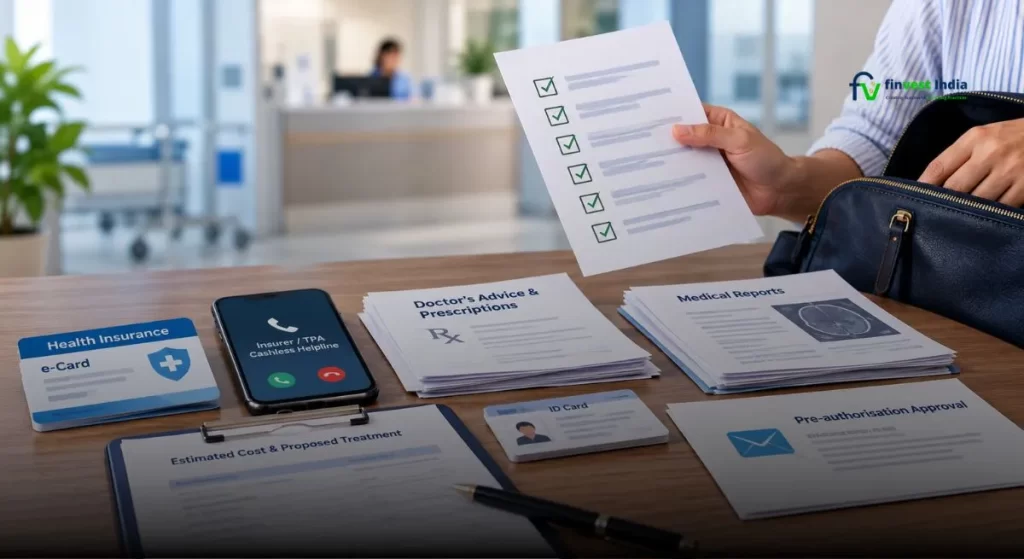
Keep these ready:
- Policy number and insurer/TPA cashless helpline
- e-card or digital policy copy
- Photo ID
- Doctor’s advice, prescriptions, and earlier reports
- Estimated cost and proposed treatment
- Pre-authorisation approval SMS, email, or request number
Save the approval reference. If the claim is delayed or partly paid, it helps you follow up quickly.
The Finvest India 7-Question Desk Check (Use It Before Every Admission)
Most guides explain the process. Few tell you what to ask at the desk. These seven questions take five minutes.
Ask the hospital insurance desk | Why it matters | Red flag |
Is cashless active for my insurer today? | Network lists change | “We’ll check later” |
What estimate did you send? | Approval follows this number | They can’t tell you |
What is the room rent per day? | Room limits can cut other charges | Costlier than your limit |
Which items may be non-payable? | You pay these yourself | No list available |
When did the insurer receive the pre-authorisation request? | The one-hour decision timeline runs from the insurer’s receipt of the request. | Nobody can confirm the receipt time or reference number. |
What is my expected co-payment? | It sets your final share | No one has checked your policy |
Who will update me if the estimate changes? | Bills often grow mid-stay | No named contact |
“When I help a family choose a plan, I don’t start with the premium. I start with which hospitals they would actually use, and whether those hospitals take cashless from that insurer. A cheaper plan with a hospital you can’t use is not cheaper.” (Approved):Prashanth Jogimutt, Founder, Finvest India
What Should You Do if Your Cashless Health Insurance Claim Is Rejected?
First, know this: a rejected cashless request doesn’t mean the treatment is excluded. The insurer may need more papers or time. You can often still file for reimbursement.
Cashless can fail when:
- the treatment falls under a waiting period,
- your policy has lapsed or the sum insured is used up,
- the hospital isn’t on the network and the Cashless Everywhere conditions aren’t met,
- medical records are missing or the diagnosis is unclear,
- the treatment is excluded,
- your room is costlier than the eligible limit, or
- the pre-authorisation request is late or incomplete.
Also know your rights. IRDAI’s 2024 Master Circular on Protection of Policyholders’ Interests (Part B) says:
- A claim can’t be rejected or closed just for missing documents or late intimation.
- If a claim is rejected or partly disallowed, the insurer must explain in writing, with reference to the specific policy terms.
- For health claims other than cashless, the circular sets a 15-day turnaround from claim submission. If the insurer misses its timeline, interest at the bank rate plus 2% applies. That’s this circular’s rule, not every claim scenario, and older guides often quote 30 days from earlier rules. Check your policy too.
- The insurer or TPA is supposed to collect documents from the hospital. Still, keep your own copies of bills and reports.
Then work through this checklist:
- Ask for the reason in writing.
- Check for missing documents or unclear doctor’s notes.
- Talk to the hospital desk. They can send clarifications fast.
- Escalate to the insurer’s grievance team. Insurers should resolve a complaint within 14 days.
- Switch to reimbursement if cashless isn’t working.
- Complain on Bima Bharosa if the insurer’s reply doesn’t settle it.
- Approach the Insurance Ombudsman only after that. It’s free and covers claims up to ₹50,00,000. But it isn’t the next step the moment a claim is rejected. You usually complain to the insurer first, and the Ombudsman’s eligibility rules on timing apply. Check them on the Ombudsman portal.
After 60 months of continuous cover, an insurer can’t contest your policy or claim on grounds of non-disclosure or misrepresentation, except for established fraud. That doesn’t make every claim payable. Exclusions, waiting periods, and limits still apply. Cover you’ve ported or migrated counts toward the 60 months.
Cashless vs Reimbursement Health Insurance: Which Claim Method Is Better?
Point | Cashless | Reimbursement |
Who pays first | Insurer pays the hospital | You pay the hospital |
Approval | Pre-authorisation before or at admission | Claim checked after discharge |
Timeline | Decision within 1 hour, discharge approval within 3 hours | 15 days from claim submission (2024 circular) |
Hospital | Network (or approved non-network) | Any eligible hospital |
Cash flow | Little upfront money | Large upfront payment |
How to Choose the Best Cashless Health Insurance in India for Your Family?
There’s no single best cashless health insurance in India. The right one depends on where you live, which hospitals you trust, and how much you can pay out of pocket. So instead of handing you a list, here’s how to build your own top 5 cashless health insurance in India shortlist. The General Insurance Council keeps an official list of health insurers. Pick five from it and score each on these seven points.
What to check | What you’ll learn | Where to check |
Nearby network hospitals | Whether your preferred hospitals take cashless | Insurer’s hospital finder, then call the hospital |
Room-rent conditions | Whether limits or proportionate cuts apply | Policy wording and CIS |
Co-payment and deductible | How much you may pay | CIS |
Waiting periods | When your conditions become eligible | CIS and policy wording |
Restoration benefit | When the sum insured refills, and for whom | Policy wording |
Claims and grievance process | How to challenge a decision | Insurer’s website; IRDAI’s Bima Bharosa |
Network count | Insurer-reported size, with source and date | Insurer’s website |
Limits of this method: It compares features, not claim quality. Check each insurer’s latest claim data in IRDAI’s annual report before you decide.
Final Thoughts
Cashless health insurance works best when you do the homework before the emergency. Read your CIS today. Check your waiting periods, co-payment, and room-rent limit. Confirm a good hospital near you accepts cashless claims from your insurer. Then, if that 2 a.m. call ever comes, you’ll know what to ask and who to call.
Know what your health insurance will actually pay for. Before an admission, check your room-rent limit, co-payment, waiting periods, and exclusions. The Finvest India team can help you understand these terms and what to ask before treatment. Explore Finvest India’s health insurance services.
Disclaimer: This article is for general information, not personal insurance advice.
Understand Your Cashless Health Insurance Coverage
FAQs on Cashless Health Insurance in India
Does Cashless Health Insurance Mean Zero Expenses?
No. You may still pay non-payable items, co-payments, deductibles, and amounts above your limits.
How Long Does Cashless Health Insurance Approval Take in India?
The insurer must decide within one hour of your request and give final discharge approval within three hours of the hospital’s discharge request.
Can I get cashless treatment at a non-network hospital?
Maybe, under Cashless Everywhere. The insurer must approve it, and the hospital must agree.
What documents do I need?
Usually your policy details, a photo ID, the pre-authorisation form, and medical records. The hospital gathers most of the rest