Bringing a new car home is a great feeling. Then the insurance form shows up and asks for a dozen things, and the mood dips a little. What if the car doesn’t have its permanent registration number yet? What if you’re renewing and the old policy is lost somewhere in your inbox?
Relax. Third-party car insurance doesn’t need a heap of paperwork. For most buyers, four things do the job: your vehicle registration details, a KYC proof, a mobile number, and an email ID. Brand-new car? The chassis and engine numbers usually work until the registration comes through. Renewing or switching insurers? Just keep the old policy number and its expiry date nearby.
Below, we’ll go through what you need in each situation, whether Aadhaar or a driving licence is a must, and what to double-check before you pay.
Is Third Party Car Insurance Compulsory in India?
Yes. As per Section 146 of the Motor Vehicles Act, 1988, a motor vehicle can not be driven in a public place without valid insurance. Section 196 prescribes the penalty for doing it nonetheless.
This part was changed recently. The Jan Vishwas (Amendment of Provisions) Act, 2026 came into force on 15 August 2026 and revised Section 196 and substituted the old punishment of imprisonment and fine with monetary penalties:
- First offense: Penalty of three times the base premium or ₹5,000, whichever is higher.
- Repeat offence: a penalty of five times the base premium or ₹10,000, whichever is higher.
So what does the policy actually do? A third-party insurance policy covers injury, death or property damage you cause to someone else. It does not cover damage to your own car. That needs a separate own-damage or comprehensive plan.
Quick Documents Checklist for Third Party Car Insurance
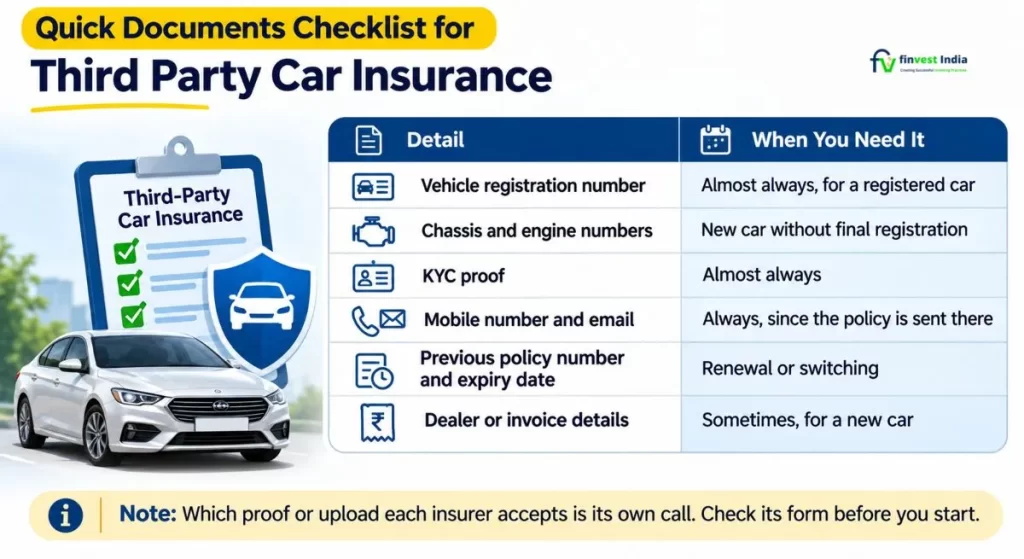
Detail | When you need it |
Vehicle registration number | Almost always, for a registered car |
Chassis and engine numbers | New car without final registration |
KYC proof | Almost always |
Mobile number and email | Always, since the policy is sent there |
Previous policy number and expiry date | Renewal or switching |
Dealer or invoice details | Sometimes, for a new car |
Which proof or upload each insurer accepts is its own call. Check its form before you start.
Is KYC Compulsory for Third Party Car Insurance? Aadhaar and PAN Explained
Yes, insurers have to know who they’re insuring. IRDAI’s Master Guidelines on Anti-Money Laundering/Counter Financing of Terrorism (2022, as amended) lay down these rules. Insurers like Bajaj Allianz also state that they apply to third-party-only policies, so you can’t skip it just because the cover is basic.
The good news is that KYC doesn’t always mean scanning and uploading papers. Depending on the insurer, it can be:
- Aadhaar-based e-KYC
- An existing KYC record you already have on file
- Digital or video KYC
The route varies from company to company, and no single ID is compulsory for every buyer. So if you don’t want to use Aadhaar, check whether your insurer takes another valid proof.
Do You Need a Driving Licence to Buy Third Party Car Insurance?
Not to buy the policy. The licence is about whether you can drive; the insurance is attached to the vehicle. Some forms never ask for it, while others do.
Even so, a few insurers may ask for licence details during the application or verification. Their reasons differ, so read your policy wording for any conditions. Keep your licence within reach, but don’t panic if the form skips it.
Documents for a New Car (Even Without a Permanent RC)
Keep these ready:
- Make, model and variant.
- Chassis and engine numbers, from your dealer’s paperwork.
- Temporary registration number, if issued.
- Invoice or dealer details, in case the insurer asks.
- KYC and contact details.
The third-party part usually runs for three years, not one. After a Supreme Court order in July 2018, IRDAI told insurers to sell only three-year third-party cover for new private cars. The own-damage part can be shorter, so a package may mix a three-year third-party cover with a one-year own-damage cover. The three-year third-party premium is paid upfront. This applies to new cars. It doesn’t force older cars into three-year policies.
A hypothetical example (an illustration, not a real customer): You’ve paid for a car on Saturday. The dealer hands over the chassis and engine numbers, but the permanent RC is a few weeks out. Some insurers can issue your third-party insurance policy on just those details. Ask yours before paying, and don’t take it for granted that the RC can follow later.
Documents for an Existing Car: Registration Number, RC and Old Policy
Keep your registration number, RC details, and previous policy ready. Some online forms fetch vehicle details automatically once you enter the registration number. Always check what they show.
Here’s how the four common situations compare:
Your situation | Keep ready | Watch out for |
New car | Chassis, engine numbers, temporary registration, KYC | Three-year term, dealer’s quote |
Existing car, renewing | Registration number, RC details, old policy number | Start date, so there’s no gap |
Switching insurers | Same, plus old policy expiry date | New policy should start when the old one ends |
Expired policy | Same as renewal | Don’t drive until the new policy is active |
Can You Buy Third Party Car Insurance Online Without Uploading Documents?
Sometimes, yes. Certain insurers let you start with just your registration number and contact details, and ask for KYC afterwards. The usual flow goes like this: enter your details, check the vehicle info on screen, choose the policy and term, look at the premium, pay, then finish any remaining verification.
ICICI Lombard’s third-party car insurance page is one example of how a single insurer runs the online process. Treat it as that company’s way of doing things, not a rule for everyone. Some insurers want uploads or extra checks before they issue the policy.
If something on screen looks wrong, stop before you pay. Your engine capacity (cc) decides your third-party premium band, so a wrong cc can mean a wrong premium. A wrong fuel type, model or chassis number can also create trouble when you try to claim. Reach out to the insurer first.
How to Renew or Switch Third Party Car Insurance (Including Expired Policies)?
Renewing: keep your policy number, registration number and registered mobile ready. Check the new start date.
Switching: keep your old policy details. Start the new policy on or before the day the old one ends. A third-party-only policy has no no-claim bonus, because that discount belongs to own-damage cover. You don’t lose it by moving.
Expired: once a policy lapses, your car is legally uninsured, so don’t drive it until the new cover is active. Ask the insurer whether it wants extra verification. Don’t assume a lapse is handled like a clean renewal.
What Can Go Wrong If Your Car Insurance Details Are Incorrect?
A small typo can turn into a headache later. Three frequent mistakes are:
- Wrong engine capacity: Your premium band depends on it, and therefore the price you see may be wrong.
- Wrong registration details: The policy will have to be changed by the insurer if it does not match your vehicle records.
- A gap between policies: Renewal isn’t automatic for everyone. If you assume it is, you could end up driving without active cover.
Here’s a hypothetical example: A car owner enters the wrong engine capacity online and pays without opening the policy schedule. Weeks later, they notice it doesn’t match the RC. What now? Contact the insurer straight away and ask for a correction. Don’t wait for a claim to find out.
Not every error cancels a policy or sinks a claim. But fixing it early is much easier.
Third Party Insurance Documents: Buying vs Claiming
Many people often mix these up. You need the documents above to buy. After an accident, an insurer may ask for documents like the policy copy, RC, driving licence and, in serious cases, an FIR. What’s needed depends on the incident and the type of claim. For injury or death, the injured person or their family usually brings the claim through a Motor Accident Claims Tribunal. Your insurer will give you its exact list.
Third Party Car Insurance Premium: What It Costs and What It Covers
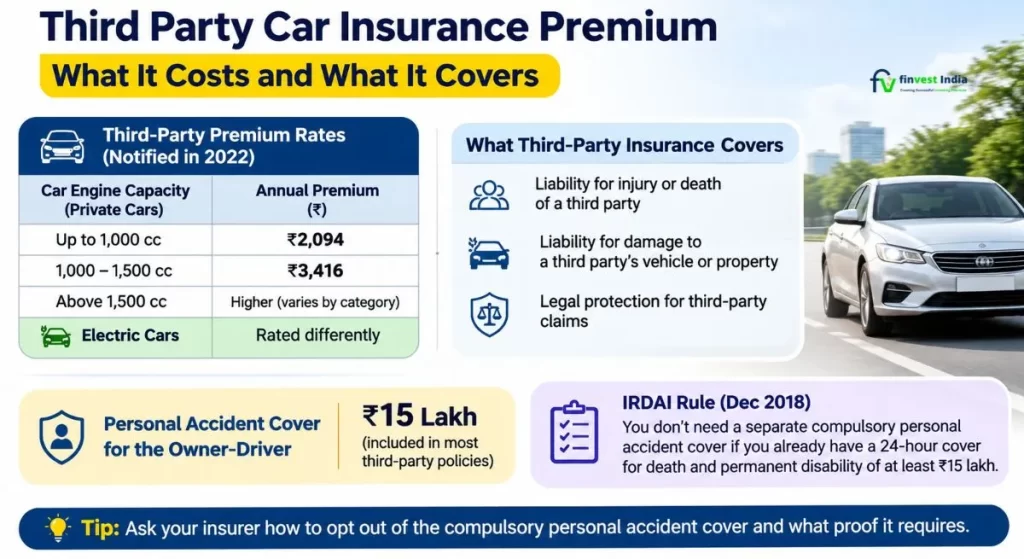
The government notifies third-party premium rates for private cars, so they’re the same across insurers. When the Ministry of Road Transport and Highways last notified them in 2022, the annual rates were ₹2,094 up to 1,000 cc and ₹3,416 for 1,000–1,500 cc. Cars above 1,500 cc pay more, and GST is added. Electric cars are rated differently. Zurich Kotak publishes the table. These are 2022 figures, so check the current rate with your insurer on the day you buy.
One saving tip. A third-party policy usually includes a ₹15 lakh personal accident cover for you as the owner-driver. This is different from third-party liability cover. Liability cover protects other people, and personal accident cover protects you. IRDAI’s December 2018 circular says you don’t need a separate compulsory cover if you already hold a 24-hour personal accident cover for death and permanent disability, with a sum insured of at least ₹15 lakh. Ask your insurer how to opt out and what proof it needs.
Expert Insight from Prashanth Jogimutt, Founder, Finvest India:
“Most people look at the price of the third-party car insurance first. I’d say look at the details first. Check the registration number, engine capacity and start date before you pay, because these small things decide whether the policy works for you later. And remember, third-party cover protects other people. Think about your own car too.”
Before You Pay, Ask Yourself These 5 Questions
Most mistakes happen in the last two minutes, when you’re rushing to pay. Run through these first:
- Do the vehicle details match my RC or dealer paperwork?
- Have I picked the right policy term? It’s three years for the third-party cover on a new car and usually one year for older cars.
- Does the policy start the day I need cover to begin?
- Do I know what third-party insurance doesn’t cover? It won’t pay for damage to your own car.
- Have I checked the final premium and policy details? Compare the amount with your quote, then save the policy document.
If you can say yes to all five, you’re good to go. If one feels shaky, pause and ask the insurer. A two-minute check now saves a lot of hassle later.
How We Checked This Third Party Car Insurance Guide?
This guide is based on the Motor Vehicles Act, 1988, IRDAI’s KYC guidelines, and IRDAI’s 2018 circular on long-term third-party cover for new cars. Where a step belongs to one insurer, we’ve said so. Finvest India started in 1999 and is run by an IRDAI-licensed insurance agent (code 02658). Rules and premiums can change, so confirm your quote with your insurer on the day you buy.
Final Thoughts
Keep your registration details, KYC, and contact details ready. Add the chassis and engine numbers if the car is new, or your old policy details if you’re renewing. Then read every detail on screen before you pay.
Not sure whether third-party or comprehensive cover suits you better? Check out our general insurance page or get in touch with us.
Need Help Choosing the Right Car Insurance?
FAQs On Third Party Car Insurance
Can I buy third-party insurance for a new car without the permanent RC?
Some insurers may accept the chassis and engine numbers along with a temporary registration. Depends on how your insurer processes claims. Check before paying.
Is Aadhaar or PAN compulsory?
KYC is expected, but no single ID is a must. Your insurer will tell you which routes it accepts.
Am I required to have a three-year policy on my used vehicle?
No, you don’t. Three-year policies are required for new cars. Used vehicles usually have one-year policies.
What if my policy expired a few days ago?
Not always. Just keep the policy number and expiry date handy in case the insurer asks.