
Top-up health insurance is a second layer of cover that pays only after your hospital bill crosses a set amount, called the deductible. The main benefits are a bigger total cover, often for a lower extra premium than raising your base policy, and protection for your savings.
Here’s why it matters. A ₹5 lakh policy feels like plenty until a surgery or a week in the ICU shows up. Medical inflation in India is roughly 12% to 14% a year, according to industry estimates in a Reuters report from 12 August 2026. At 12%, a ₹5 lakh bill today could be about ₹8.8 lakh in five years. That is our own illustration, not a forecast.
The catch is the deductible. Pick the wrong one, and you could still pay lakhs yourself. Below, we’ll cover the benefits, how a claim works with real numbers, and what to check before you buy.
What Is a Top-Up Health Insurance Policy?
A top-up health insurance policy works alongside your base policy or your employer’s group cover. It doesn’t replace either.
The deductible is the amount of eligible expenses that must be reached before the top-up starts paying. People often mix this up. It is not the maximum the insurer pays. IRDAI’s Customer Information Sheet, which insurers must give with every policy, lists the deductible next to the sum insured, sub-limits, and waiting periods. Read that sheet first.
Whether your base insurer’s payment counts towards the deductible depends on the policy wording. Some plans also count what you pay yourself. Some exclude certain expenses. Check this clause also before you buy.
Key Benefits of Top-Up Health Insurance Plans
Here are the benefits of top-up health insurance, along with the condition attached to each.
- Higher total cover without replacing your base policy. The top-up works only after the deductible is met.
- A potentially lower additional premium. Because you carry the deductible, extra cover often costs less than raising your base sum insured. Often, not always, so compare real quotes.
- Protection for your savings. A long ICU stay or major surgery can wipe out years of savings. Top-up medical insurance covers the large part of such a bill, if the claim is eligible.
- A fix for thin employer cover. Many group plans have a modest sum insured. A personal top-up fills the gap, but it must fit your group cover’s limits.
- A deductible you choose. A higher deductible usually lowers the premium. A cheap plan with a deductible you can’t afford is a bad deal.
- Possible tax savings. See the tax note below.
What Does Top-Up Health Insurance Cover?
Coverage, limits, medical-necessity rules and exclusions differ by policy, so check your wording. Depending on the plan, covered expenses may include:
- In-patient hospitalisation.
- Room rent and ICU expenses, within the plan’s limits.
- Doctor, nursing, surgical and diagnostic charges.
- Day care operations that do not require an overnight stay.
- Pre-hospitalization & Post-hospitalization costs.
- Ambulance fees, up to policy limits.
- Domiciliary treatment, if medically necessary, insurer-approved, and covered.
- Organ donor expenses, where the policy includes them.
- Modern or AYUSH treatments, only where the policy specifies them.
What Top-Up Health Insurance Usually Does Not Cover?
- OPD consultations without hospitalisation.
- Cosmetic or non-medically necessary procedures.
- Expenses during applicable waiting periods.
- Non-medical consumables.
- Treatment excluded under the policy.
- Amounts above sub-limits or room-rent restrictions.
- Claims affected by co-payment.
- Expenses that do not qualify toward the deductible.
How Does Top-Up Insurance Coverage Work During a Claim?
Take a ₹5 lakh base policy and a ₹20 lakh top-up with a ₹5 lakh deductible. These examples assume that:
- every expense is eligible,
- the base insurer’s payment counts towards the deductible,
- the base insurer pays its full ₹5 lakh,
- no co-payment, room-rent limit or sub-limit applies.
Hospital bill | Base policy pays | Top-up pays | You pay |
|---|---|---|---|
₹3 lakh | ₹3 lakh | ₹0 | ₹0 |
₹5 lakh | ₹5 lakh | ₹0 | ₹0 |
₹8 lakh | ₹5 lakh | ₹3 lakh | ₹0 |
₹10 lakh | ₹5 lakh | ₹5 lakh | ₹0 |
Now the tricky case. Say your base cover is only ₹3 lakh, but your top-up deductible is ₹5 lakh. On an ₹8 lakh bill, the base pays ₹3 lakh, and the top-up pays ₹3 lakh (the bill minus the deductible). The ₹2 lakh in between usually falls on you. A top-up pays what sits above its own deductible, not whatever your base policy leaves behind.
Top-Up vs Super Top-Up: What’s the Difference?
A regular top-up checks the deductible on each claim separately. A super top-up adds up your eligible expenses across the policy year.
Before you compare them, two terms are worth knowing:
- Base policy limit: The maximum your basic health insurance will pay in the policy year. In this scenario, it is ₹5 lakh.
- Top-up deductible: The amount you need to spend before the top-up kicks in. Here, it is also ₹5 lakh.
Feature | Regular top-up | Super top-up |
Deductible calculation | Usually claim-wise | Usually cumulative during the policy year |
Best for | One large hospital bill | Multiple hospitalisations |
Two ₹3 lakh claims with ₹5 lakh deductible | May pay nothing | May pay ₹1 lakh (₹6 lakh minus ₹5 lakh) |
Premium | May be lower | May be higher than a similar regular top-up |
Main question to ask | Is the deductible applied per claim? | Which expenses accumulate toward the deductible? |
What Affects Super Top-Up Health Insurance Premiums?
A super top-up premium chart is a table, published by the insurer, that lists the yearly premium for each age band, sum insured and deductible. Prices differ a lot between insurers, so we won’t print one set of rupee figures here. Here’s how to read any chart:
If you… | The premium usually… |
|---|---|
Raise the deductible | Falls |
Raise the sum insured | Rises |
Move to an older age band | Rises, with bigger jumps at older ages |
Add family members | Rises, depending on the plan |
Live in a costlier city | Can rise |
Where to find the real chart: insurers usually publish rates on their website or in the product brochure. Pick one age band, one deductible and one sum insured, then compare two or three insurers on the same inputs.
Charts show base rates. Your health history can change the final price, and group policies carry 18% GST that individual ones don’t.
How to Choose the Right Deductible for Top-Up Health Insurance?
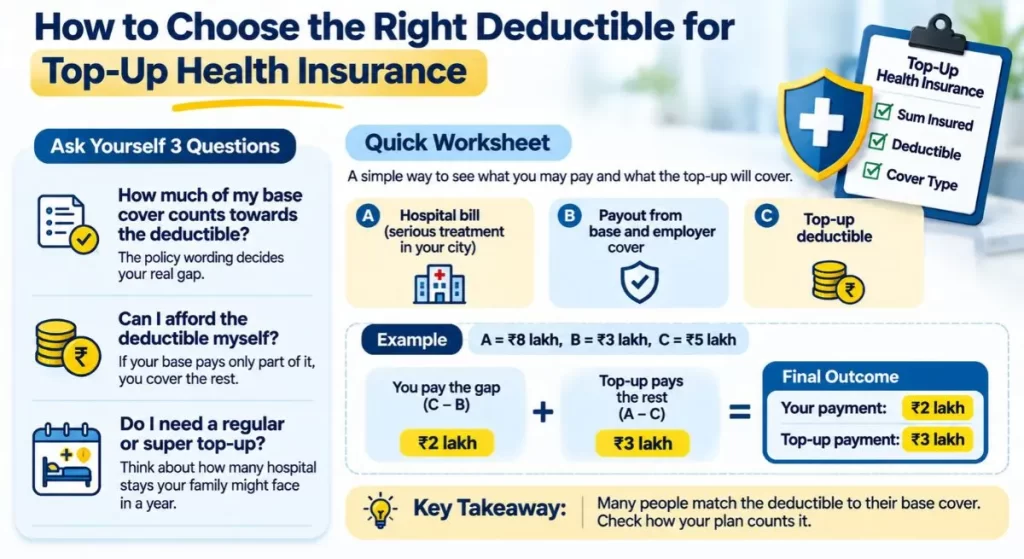
Ask yourself three things:
- How much of my base cover counts towards the deductible? The policy wording decides your real gap.
- Can I afford the deductible myself? If your base pays only part of it, you cover the rest.
- Do I need a regular or super top-up? Think about how many hospital stays your family might face in a year.
Quick worksheet: A is a serious hospital bill in your city. B is what your base and employer coverage will actually pay. C is the top-up deductible. If B is less than C, you pay the gap (C minus B) before the top-up starts. If A is more than C, the top-up pays the rest, up to its sum insured. Try A = ₹8 lakh, B = ₹3 lakh, C = ₹5 lakh: you pay ₹2 lakh, the top-up pays ₹3 lakh. Many people match the deductible to their base cover. Check how your plan counts it.
Top-Up Health Insurance Mistakes That Can Cost You Money
- Deductible below your base cover. This can mean paying for overlap, but the value depends on how the plan defines the deductible, what counts towards it, and the premium gap.
- Two insurers, no cashless check. The second claim may be reimbursement only.
- Informing the top-up insurer late. Each plan sets its own intimation deadline. Check your claim-intimation clause.
- Expecting OPD cover. Most top-ups are built for hospital stays.
Before purchasing a policy, review the deductible, exclusions, waiting periods, claim procedures and hospital network carefully. If you need help comparing policies, understanding deductibles or selecting suitable coverage, explore health insurance services in Bangalore for guidance on evaluating health insurance options based on your family’s medical needs and budget.
Who Should Consider Top-Up Health Insurance?
- People with low base cover: People who have bought a ₹2 lakh or ₹3 lakh coverage and require extra cover for big hospital costs.
- Salaried employees: People using their company health insurance but looking for additional coverage that isn’t associated with their employment.
- Families: Those who seek greater medical care for a potentially lower extra premium.
- Metro-city residents: Those with high treatment costs and who worry their current cover may fall short.
- People insuring aging parents: Those looking for additional cover, subject to age, eligibility, premiums and waiting periods.
- Self-employed: Those who have an appropriate base insurance but wish to extend their overall health cover.
Prashanth Jogimutt, Finvest India: Most people ask about the premium first. I’d start with the deductible clause. Ask three things: what counts towards it, whether it applies per claim or across the year, and what happens to your cover if your employer policy ends. A cheap plan you can’t use when you need it isn’t cheap.”
When May a Top-Up or Super Top-Up Not Be Suitable?
A top-up can fall flat if your base cover is unreliable, the deductible is too high for you, or your worry is small bills.
Take a hypothetical example: Meera, 38. Her employer gives her ₹5 lakh group cover, and she adds a ₹20 lakh super top-up with a ₹5 lakh deductible.
In one year, she has two hospital stays: ₹3 lakh and ₹4 lakh. The employer policy pays ₹3 lakh first, then only the ₹2 lakh it has left. Her eligible bills total ₹7 lakh, so the super top-up pays ₹2 lakh above the deductible. A regular top-up would pay zero, since neither bill crosses ₹5 lakh, and she’d cover ₹2 lakh herself.
Then she changes jobs, and the group cover ends. If she has no personal base policy, she may have to meet the first ₹5 lakh herself, depending on what her plan’s wording counts. A personal base policy avoids this.
This is a simplified example. It assumes all expenses are eligible, both claims fall in one policy year, and there’s no co-payment, room-rent limit, sub-limit, or exclusion.
.
Top-Up Health Insurance in India: Rules That Matter in 2026
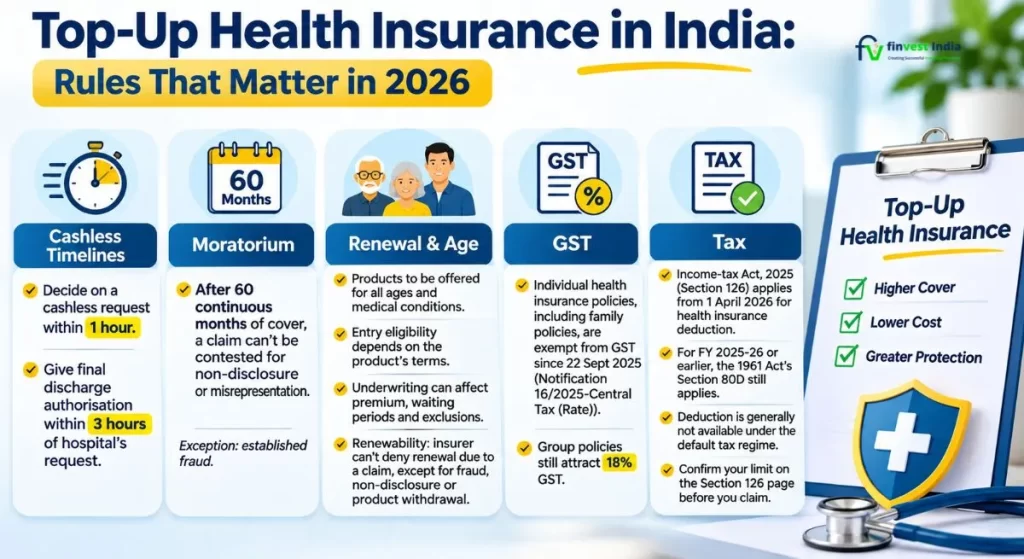
These points come from official documents, and each is tied to its source below.
Cashless timelines: IRDAI’s Master Circular on Health Insurance Business (ref. IRDAI/HLT/CIR/PRO/84/5/2024, dated 29 May 2024) says insurers must decide on a cashless request within one hour. They must give final discharge authorisation within three hours of the hospital’s request. This is a deadline for the insurer.
Moratorium: The same circular says that after 60 continuous months of cover, a claim can’t be contested for non-disclosure or misrepresentation. Established fraud is the exception.
Renewal and age: The circular requires insurers to offer products for all ages and medical conditions. It also says this doesn’t mean one product must suit everyone. Three things are separate:
- Entry eligibility depends on the product’s terms.
- Underwriting is the insurer’s assessment of your health and risk. It can affect your premium, waiting periods, and exclusions.
- Renewability means that once you hold a policy, the insurer can’t deny renewal because you made a claim. It can refuse in cases of established fraud or non-disclosure, or if the product is withdrawn (in which case you get migration options). It can’t run fresh underwriting unless you raise the sum insured, and then only on the increase.
So a senior citizen may be able to buy a top-up, but the price and terms can be much less favourable. Compare quotes and read the customer information sheet.
GST: Individual health insurance policies, including family policies, have been exempt from GST since 22 September 2025 under Notification 16/2025-Central Tax (Rate). The Department of Financial Services FAQ confirms group policies still attract 18%. Check your quote to see which applies to you.
Tax: The Income-tax Act, 2025 applies from 1 April 2026. Section 126 now covers the health insurance deduction, which used to be Section 80D. For income earned in FY 2025-26 or earlier, the 1961 Act’s Section 80D still applies. The deduction is generally not available under the default tax regime, so check which regime you use. Confirm your limit on the Section 126 page before you claim.
What to Do on Claim Day With Two Insurers?
- Tell both insurers early: Do it at admission or soon after. Keep both policy numbers handy.
- Choose where to claim first: IRDAI’s circular says a policyholder with multiple policies can file under any of them. That insurer acts as the primary insurer. If its cover is less than the admissible claim, it coordinates with your other insurer for the balance, as per policy conditions. Your top-up’s deductible terms still apply.
- Use cashless on the base policy at a network hospital, if you can.
- Ask the hospital what documents the insurer has asked for: The circular says insurers and TPAs should collect documents from hospitals, but keep your own copies of bills, the discharge summary, reports, and your ID.
- Keep the base insurer’s settlement letter: A top-up insurer usually wants proof of what the base policy paid.
- Expect reimbursement on the top-up: Some plans offer cashless, but many settle later. Check yours.
Give one family member both policy numbers and the insurer helpline numbers. In an emergency, that saves time.
Final Thoughts On Top-Up Health Insurance
Top-up health insurance can raise your available cover without an equal rise in your base premium. Its value depends on the deductible, the eligible expenses and the policy wording. Review your current cover, pick a deductible you can handle, and compare plans on equal terms.
Not sure which deductible fits your base cover? Send us your current sum insured, city, and family size, and the Finvest India team can help you compare top-up options.
Disclaimer: This article is for general information and isn’t a contract of insurance or professional advice. Check your insurer’s policy wording and your own tax position before deciding.
Choose the Right Top-Up Health Insurance for Your Family
FAQs on Top-Up Health Insurance
Is top-up health insurance worth it?
It can be, if your base cover is lower than what a serious hospital stay could cost and you can handle the deductible. It is less useful if your base cover is already high.
Is a top-up cheaper than a bigger base policy?
Often, yes, because you carry the deductible yourself. Don’t assume it. Get two quotes for the same people and city: one ₹25 lakh base policy, and a ₹5 lakh base plus a ₹20 lakh top-up. Sometimes the gap is big enough to settle it. If the two quotes are close, take the single bigger policy and skip dealing with two insurers.
Can I buy a top-up from a different insurer?
Often yes, if the product allows it. Cashless on the second claim depends on each insurer’s terms and hospital network. One insurer for both may make coordination simpler, so compare terms.
Is top-up the same as critical illness cover?
No. A top-up pays hospital bills above the deductible. Critical illness plans usually pay a fixed sum on diagnosis of a listed illness.