
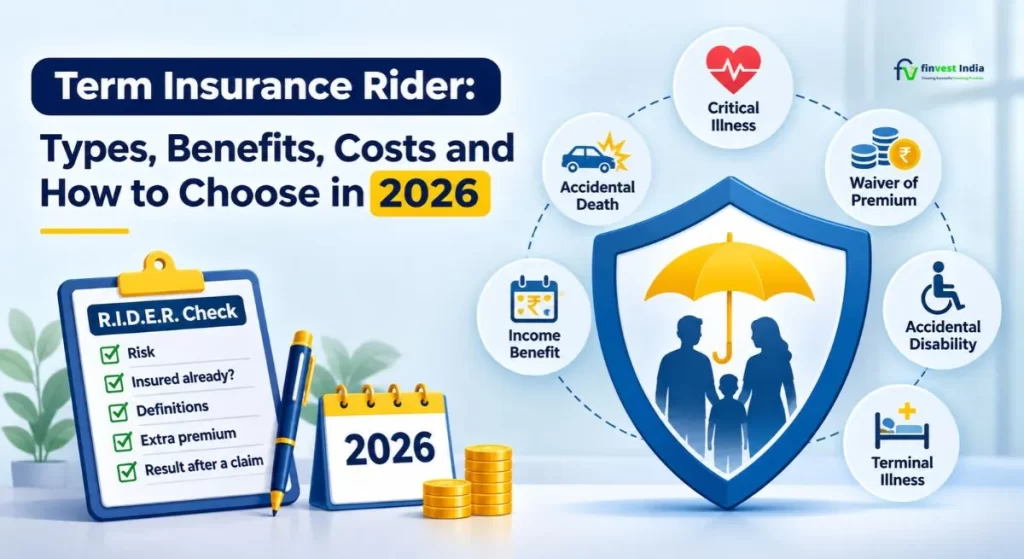
Term Insurance Rider: Types, Benefits, Costs and How to Choose in 2026
A term insurance rider is an optional add-on to your basic term coverage. Where available, this can also provide coverage for some risks not covered by your basic plan, e.g., an accident, a permanent disability or a critical disease, for an additional price.
Life insurance settled 97.82% of individual death claims by number and 96.29% by amount, the IRDAI’s Annual Report 2024-25 said. That is an industry-wide death claim figure, not a rider claim ratio. A rider pays only when your situation matches the policy’s exact definition, so the fine print matters more than the rider’s name.
GST on individual life insurance policies has been exempt since 22 September 2025, while employer-sponsored group life policies still attract 18% GST.
In this blog, we’ll walk through the types of term insurance riders, their benefits, how to choose the best riders for term insurance, and a simple check that keeps you from paying for cover you don’t need.
Table of Contents
Key Takeaways
- A rider adds one specific protection to your base plan. It never replaces enough life cover.
- The six common riders cover accidental death, critical illness, premium waiver, accidental disability, terminal illness, and regular income. Availability varies by insurer.
- Claim definitions decide everything: illness lists, disability wording, waiting and survival periods.
- IRDAI’s limits are ceilings, not targets: up to 100% of base premium for health and critical illness riders, and 30% for all other riders combined.
- Before you buy, check the rider’s term, the claim paperwork, and what happens to your base plan after a claim.
- Run the R.I.D.E.R. Check and compare wording from at least two insurers, so you pay only for the gaps you actually have.
What Is a Term Insurance Rider?
The definition of an insurance rider is simple: it’s an extra provision attached to a base policy that adds one specific benefit. These are also called term insurance add-on benefits. You can skip them, but some people genuinely need one.
Here’s an illustrative example. Ananya, 32, has a ₹1 crore term plan and a ₹25 lakh accidental death rider. If she dies in a covered accident, her family gets ₹1.25 crore. If she dies of an illness, they get ₹1 crore. The rider pays only for the risk it names.
One catch: some riders pay on top of your base cover, while others are carved out of it. Always ask which one you’re getting.
6 Types of Term Insurance Riders in India

Names and terms vary by insurer, so treat this as a general map, not a fixed list.
1. Accidental Death Benefit Rider
An accidental death benefit rider pays an extra lump sum if you die in a covered accident. IRDAI’s Master Circular on Life Insurance Products lets its sum assured go up to three times your base cover, a higher limit than other riders get. Read the exclusions, since risky activities and self-inflicted injuries are often left out. Check your existing personal accident cover before buying.
2. Critical Illness Rider
A term insurance critical illness rider pays a lump sum when you’re diagnosed with a listed condition, such as a heart attack, stroke, or cancer of a defined stage. Check the waiting period (the time before you can claim) and the survival period (how long you must live after diagnosis).
3. Waiver of Premium Rider
If a covered event occurs, such as a critical illness or permanent disability, the insurer will pay the remaining premiums and your life cover will remain in force. A waiver of premium rider is suitable for sole earners, but the triggers vary between insurers, so check which events are covered.
4. Accidental Disability Rider
It pays when an accident leaves you permanently disabled, totally or partially. Definitions matter here. Some policies cover only specific losses, like a limb or eyesight, not “unable to do your job.” It’s worth a look if you do manual or field work.
5. Terminal Illness Rider
It releases the death benefit early if you’re diagnosed with a terminal illness. Many insurers build this into the base plan for free, so check before paying for it. An early payout also reduces what your nominee gets later.
6. Income Benefit Rider
It pays your family a regular monthly income instead of, or along with, a lump sum. Often this is a payout option inside the base plan, not a paid rider, so look there first.
What happens after a claim? Ask the insurer these before you buy:
Rider | Question to ask |
Accidental death | Does my base life cover stay unchanged? |
Critical illness | Is the payout additional or taken from my base cover? |
Waiver of premium | Which premiums are waived, and from when? |
Accidental disability | Does the rider continue after a payout? |
Terminal illness | How much death benefit remains for my nominee? |
Income benefit | Does it replace or add to the lump sum? |
Benefits of Term Insurance Riders (and Where They Fall Short)
The real benefits of term insurance riders:
- They cover you while you’re alive: Your base plan can’t do that.
- One policy to manage instead of several.
- Your cover survives a bad year: A waiver of premium stops a covered illness from lapsing your plan.
The trade-offs: more premium, strict definitions and exclusions. A rider also isn’t always as broad as a standalone policy, so compare both before deciding.
How Much Does a Term Insurance Rider Cost? IRDAI’s Limits
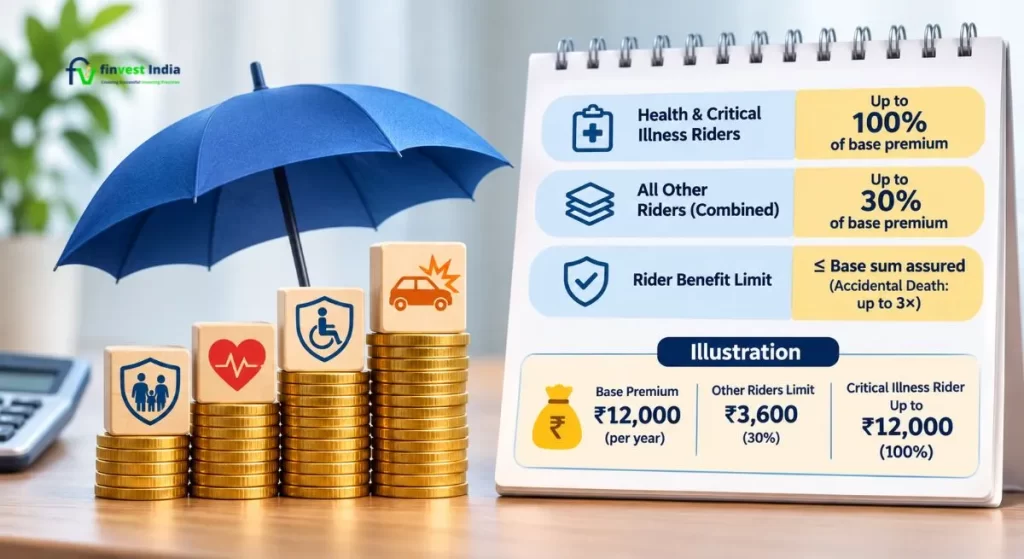
The same Master Circular (12 June 2024) sets the ceilings:
- Health and critical illness rider premiums: up to 100% of your base premium.
- All other riders combined: up to 30% of your base premium.
- Each rider’s benefit: no more than the base sum assured, except accidental death (up to three times).
Illustration: if your base premium is ₹12,000 a year, non-health riders together can’t cross ₹3,600, while a critical illness rider could go up to ₹12,000. Those are caps, not prices. Your actual cost depends on your age, health, cover amount, and insurer.
To see a real price, ask two insurers to quote the same age, cover, and term with and without the rider, and note the date. The gap is the rider’s cost. We found no amendment to these limits as of 25 November 2026, but confirm the latest version before you buy.
How to Choose the Best Riders for Term Insurance: The R.I.D.E.R. Framework ?
Most blogs list riders and stop. Here’s a method instead.
- R: Risk. What would hurt your family most if you were alive but couldn’t earn? Loan EMIs, school fees, treatment bills? Pick the risk first, then the rider.
- I: Insured already? Check employer cover, your health insurance, and personal accident policies. Employer group term cover may cease when your employment ends, subject to the group policy’s terms and any continuation or conversion options. Group term premiums also still attract 18% GST.
- D: Definitions. Read the illness list, survival period, and disability wording. Two insurers can use the same rider name and mean different things.
- E: Extra premium. Ask what the rider adds per year, whether it fits IRDAI’s caps, and how it compares with a standalone policy.
- R: Result after a claim. Does the base cover continue? Do future premiums stop? Does the payout reduce your nominee’s amount?
A Real Finvest India Case (Details Anonymised)
We compared family floater health plans for a salaried professional in Bengaluru, covering four members. Two quotes were close on price: Insurer A asked ₹28,214 a year, and Insurer B asked ₹29,650, both including GST and neither with a personal accident add-on.
The ₹1,436 gap hid a bigger difference. Insurer A offered an unlimited sum insured and no waiting period for pre-existing diseases. Insurer B offered a ₹20 lakh sum insured and a three-year waiting period.
Price alone would have pointed us to the wrong question. That is the “D” in the R.I.D.E.R. Check: compare definitions and waiting periods before you compare premiums. A critical illness rider works the same way.
Finvest India’s Expert Insights On Term Insurance Riders
- Fix the base cover first: Don’t shrink your sum assured to afford add-ons. A rider can’t replace adequate life cover.
- Compare conditions, not just premiums: Coverage limits, waiting periods, and exclusions decide whether a claim actually works.
- Match riders to a real gap: Buying cover without understanding your need is like taking medicine without seeing a doctor first.
Finvest India has been around since 1999 and is run by an IRDAI-licensed agent. If you’d like to run this framework on your own plan, our life insurance services in Bangalore can walk you through it.
The Rider Overlap Map: Match Your Life, Not the Brochure
Your situation | What you may already have | Rider to check | Question to ask |
Salaried, with employer cover | Group health, maybe group term that may end with the job | Critical illness, waiver of premium | “What’s left if I switch jobs?” |
Self-employed or freelancer | Often nothing | Accidental disability, waiver of premium | “How long can my family manage if I can’t earn?” |
Sole earner with a home loan | Basic health cover | Waiver of premium, accidental death | “Who pays premiums and EMIs if I can’t?” |
Salaried, strong personal health and accident cover | Personal health and accident policies | Possibly none beyond the base plan | “What gap is left after my existing cover?” |
These are starting points, not recommendations.
The “tell your nominee” rule: A rider claim is separate from a death claim. Write down which riders you hold and where the policy papers are, then tell your nominee. A rider nobody knows about is a rider nobody claims.
If a claim is wrongly denied, raise it with the insurer first, then use IRDAI’s Bima Bharosa portal.
Final Thoughts
Here’s the simple truth: a rider isn’t about collecting extras. It’s about closing one specific gap in your family’s safety net.
Start with enough life cover, run the R.I.D.E.R. Check, and read the definitions as if they were the contract, because they are. Not sure which add-on fits? Our advisors can compare the wording with you. Talk to us or browse our resource page for more guides.
Disclaimer: This article is for general information and awareness only. It is not insurance, financial, tax, or legal advice, and examples are illustrative, not guaranteed outcomes.
Choose the Right Term Insurance Riders for Your Needs
FAQs on Term Insurance Riders
Are term insurance riders compulsory?
No. They’re optional, and you can buy a base plan alone.
Can I add a rider later?
It depends on the insurer and the product. Some allow it only at purchase.
Is a critical illness rider better than a separate policy?
Not at all. A rider is convenient, but you can get a standalone health insurance policy which may provide a different sum insured and terms. See the illness list, exclusions, and compensation.
Is GST charged on riders in 2026?
Individual life insurance premiums have been GST-exempt since 22 September 2025, while group term cover still attracts 18%. Check your premium illustration to see how it applies to your rider.