
Health Insurance Portability in India: Rules, Benefits and How to Switch Policies (2026 Guide)
Picture this. Your are paying your health insurance premiums for four years. Then your insurer’s claims service disappoints you, or the policy stops fitting your family. You want to switch, but one worry holds you back: will you lose the waiting-period credit you already earned?
That’s where health insurance portability helps. It lets you move your policy to a new insurer and carry forward eligible benefits, as long as the new insurer approves you.
The short version: apply 30 to 60 days before renewal. Your waiting-period credit, no-claim bonus and moratorium credit can travel with you. Approval and identical terms aren’t guaranteed. Below, you’ll find the rules, the steps, and the situations where switching backfires
Portability at a Glance (November 2026)
- Application window: 30 to 60 days before renewal.
- Old insurer shares your data: within 72 hours.
- New insurer decides: within 5 days of receiving that data.
- Portability fee: none.
- Moratorium: 60 months of continuous cover, and ported credits count.
The deadlines are according per IRDAI’s Master Circular on Health Insurance Business (29 May 2024). Please refer recent IRDAI circulars before applying as the regulatory requirements are subject to change.
What Is Health Insurance Portability?
Health insurance portability lets you transfer your existing policy to another insurance company. You don’t start from zero. You carry forward the eligible benefits you’ve already earned.
Say you hold a ₹5 lakh policy and have completed two years of a 36-month waiting period for pre-existing diseases. You’re unhappy with your insurer. Through portability, the new insurer can recognise those two years, so you may only need to wait one more year.
The new insurer still checks your application, medical history and the cover you ask for. These rules also apply to indemnity health policies. Fixed-benefit plans work differently, so ask the insurer before you assume anything.
People often mix this up with migration. Here’s the difference:
Portability | Migration | |
What changes | The insurer | The plan, same insurer |
Credits | Carried over, up to old sum insured | Carried over, up to old sum insured |
Who decides | New insurer’s underwriting | Your current insurer’s migration terms |
Happy with your insurer but not your plan? Look at migration. Unhappy with the insurer itself? That’s where portability comes in.
What Are the IRDAI Rules for Health Insurance Portability in India?
The IRDAI portability guidelines cover timelines, benefit transfer, and what both insurers must do. These are the most important of the health insurance portability rules.
- Apply 30 to 60 days before renewal: Send your request to the new insurer at least 30 days before, and no earlier than 60 days before, your renewal date. If your policy renews on 30 June, your window runs from about 1 May to 31 May. An insurer may also consider a request within 15 days of renewal. That’s its call, not your right, and it must ensure no break in cover. Don’t treat it as an extension.
- Eligible credits can transfer: These include your sum insured, accumulated no-claim bonus, specific-disease and pre-existing disease waiting periods, and moratorium credit. Transfer follows the regulations and the new policy’s terms. Not everything or every add-on transfers over instantly.
- Portability at renewal: This is applicable to individual, family floater and group policies. Switch over at roughly the same time as the renewal.
- Portability at no cost: You can port your health insurance without any cost.
- The new insurer can underwrite you: It can assess your age, medical history, past claims, and the cover you want before it decides.
Your Portability Calendar (Example)
Say your policy renews on 31 January 2027:
Step | Date or timeline |
Window opens (60 days before) | 2 December 2026 |
Smart target to apply (45 days before) | 17 December 2026 |
Window closes (30 days before) | 1 January 2027 |
Old insurer shares data | Within 72 hours of the request |
New insurer decides | Within 5 days of receiving data |
Your old policy | Keep it active until the new one is confirmed |
These are stage deadlines, not a promise that the whole switch finishes in five days. Your old insurer shares the data through the Insurance Information Bureau of India (IIB) portal.
Important Health Insurance Regulatory Changes Since 2024
Update | What it means for you |
PED and specific-illness waiting periods are capped at 36 months under IRDAI’s 2024 product regulations. | Older policy documents may still show longer periods, so read yours. |
After 60 months of continuous cover, claims can’t be contested for non-disclosure, except proven fraud (IRDAI health master circular) | Ported credits count towards the 60 months |
Renewal can’t be refused because you claimed, and fresh underwriting applies only to a higher sum insured | Staying put carries less underwriting risk than switching |
Cashless requests must be decided within 1 hour, and final discharge approval within 3 hours | Ask both insurers how they perform on this |
Individual and family floater premiums are GST-exempt from 22 September 2025, per the Department of Financial Services. Group policies fall outside | Compare quotes like for like |
Under IRDAI’s 30 January 2025 circular, insurers offering indemnity-based individual health insurance products to senior citizens must consult IRDAI before implementing annual premium increases exceeding 10%. | Useful context if you’re a senior comparing renewal hikes |
Who Is Eligible for Health Insurance Portability?
You can apply if:
- You hold an active indemnity health policy with an IRDAI-registered insurer.
- Your cover has been continuous, with no lapse.
- You apply within the 30-to-60-day window.
- Every person you want to port is named in the application.
- Portability of group health insurance is also possible.
The new insurer still has the final say.
What Are the Benefits of Health Insurance Portability?
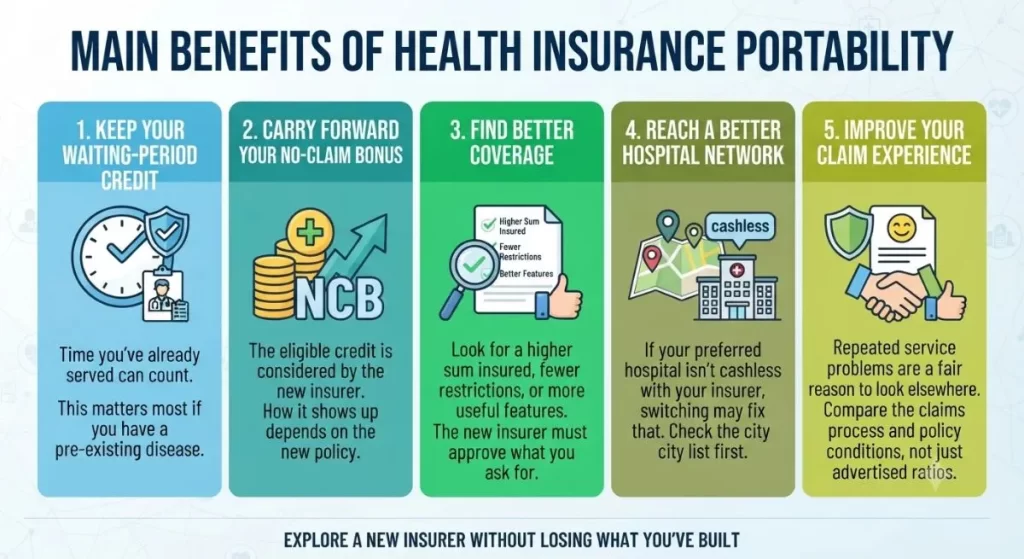
Portability lets you explore a new insurer without automatically losing what you’ve built. Here are the main health insurance portability benefits.
- Keep your waiting-period credit: Time you’ve already served can count. This matters most if you have a pre-existing disease.
- Carry forward your no-claim bonus: The eligible credit is considered by the new insurer. How it shows up depends on the new policy.
- Find better coverage: Look for a higher sum insured, fewer restrictions, or more useful features. The new insurer must approve what you ask for.
- Reach a better hospital network: If your preferred hospital isn’t cashless with your insurer, switching may fix that. Check the city list first.
- Improve your claim experience: Repeated service problems are a fair reason to look elsewhere. Compare the claims process and policy conditions, not just advertised ratios.
How to Port Health Insurance from One Company to Another?
Here’s how to port health insurance, step by step. The health insurance switching process takes more than one form.
Step 1: Review Your Existing Policy
Note your sum insured, renewal date, waiting periods served, no-claim bonus, exclusions, and sub-limits. Check that it covers every family member you want to insure.
Step 2: Compare Other Plans
Don’t pick on premium alone. Score each policy out of five on:
- room rent limits.
- co-payment.
- disease-wise sub-limits.
- restoration benefits.
- pre- and post-hospitalisation cover.
- day-care treatments.
- your preferred hospitals in the cashless network.
Step 3: Upload Portability and Proposal Forms
Obtain the portability form and proposal form from the chosen insurance. The portability form allows it to acquire your coverage and claim history.
Step 4: Exchange Medical Information & Documents
Please send the insurance papers, claim data and any other medical information you require. Be honest about your symptoms, treatments and hospital visits. Mistakes or omissions could cause issues with underwriting or when you have to file a claim down the line.
Step 5: Final Approval by Underwriting
The insurance company is going to look at your risk. It could mean more paperwork or health checks.
Step 6: Review the Decision
The insurer may agree, provide altered terms or refuse. Read the terms before you sign.
Step 7: Verify the New Policy
Don’t terminate or let your current coverage lapse just because you applied. Write down the new start date and coverage. Avoid any gap.
Documents Required for Health Insurance Portability
Requirements vary by insurer. Keep these ready:
- Policy paper and most recent renewal notice
- Previous policy copies available on request.
- Filled out portability and proposal forms.
- Details of the previous claim.
- Medical records as well as test results, if there are any.
- Proof of identity and address.
- Details of all members of the family insured.
What Happens to Your Waiting Period When You Port?
Most policies carry waiting periods for pre-existing diseases and specified illnesses. The 2024 master circular caps the pre-existing disease wait at 36 months, though many older policies had four years. Check your own policy schedule.
Eligible credit moves with you. Suppose you’ve completed three of four years. If the new policy recognises that credit, you generally need only the remaining year, subject to its terms.
What If You Increase Your Sum Insured?
Say you hold ₹5 lakh and want ₹10 lakh while porting.
- Existing ₹5 lakh: eligible continuity credits can transfer.
- Extra ₹5 lakh: the insurer may underwrite it separately, and fresh waiting periods may apply.
Never assume your old credit covers the added amount.
(Illustrative scenario, not a real client file) Ravi held a ₹5 lakh policy with three years of waiting-period credit. He ported and asked for ₹10 lakh. The new insurer accepted the ₹5 lakh with his credit intact. It underwrote the extra ₹5 lakh separately, with fresh waiting periods. Lesson: credit moves only up to your old sum insured.
Does Portability Reset the Moratorium Period?
No. Continuous cover, including ported and migrated credits, counts toward the 60-month moratorium. After 60 continuous months, claims generally can’t be contested for non-disclosure or misrepresentation, except for established fraud. For any increased sum insured, the 60 months count separately from the date of enhancement.
Can You Port Health Insurance with a Pre-Existing Disease?
Yes. Diabetes or hypertension doesn’t automatically block you. The new insurer will review your treatment records, claims, and current health. It may ask for tests or offer modified terms. Disclose every relevant condition. Hiding one to improve your odds can hurt you badly later.
What Are the Disadvantages of Health Insurance Portability?
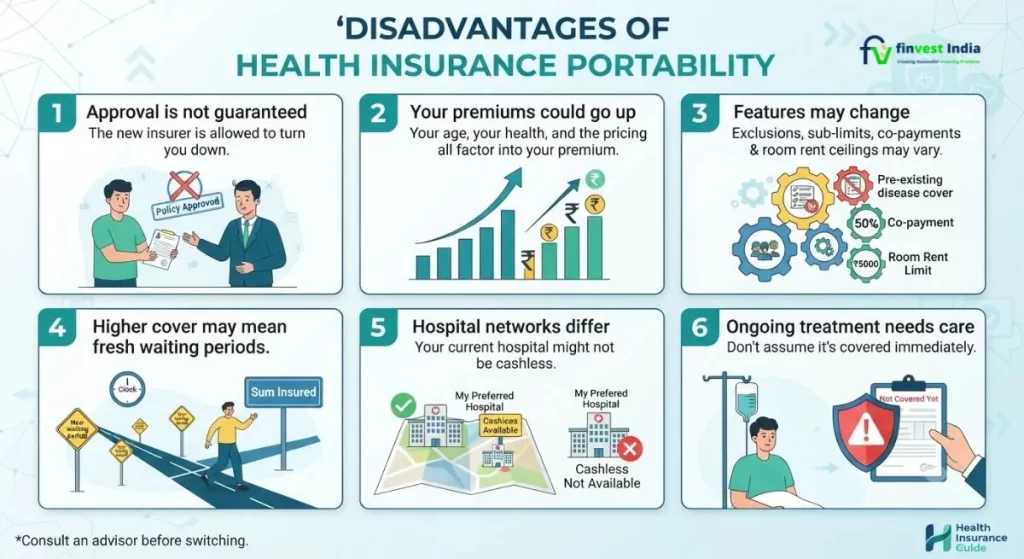
- Approval is not guaranteed: The new insurer is allowed to turn you down.
- Your premiums could go up: Your age, your health and the pricing all factor into your premium.
- Features may change: Exclusions, sub-limits, co-payments & room rent ceilings may vary.
- Higher cover may mean fresh waiting periods.
- Hospital networks differ: Your current hospital might not be cashless.
- Ongoing treatment needs care: Don’t assume it’s covered immediately.
Five Situations Where Switching Can Backfire
Most guides tell you how to port. Few tell you when not to. Watch for these five.
- Switching just before a planned surgery: Underwriting takes time. The terms may change, and your hospital may not be in the new network. Sort out the surgery cover first.
- Switching after a new health condition: Your current insurer generally renews you without fresh underwriting. A new insurer will assess you from scratch and may load your premium or decline.
- Switching for premium savings only: A lower quote can have a room rent cap or a co-payment that can be far more expensive when you make a claim. GST is now 0% on Individual Plans. Compare basic premium vs perks.
- Increase your cover without checking waiting periods, and the extra quantity may start a new timer.
- Leaving a strong insurer: If your hospital network, claim record, and terms already work for you, think hard before giving up years of credit.
When Should You Port Your Health Insurance Policy?
Consider it if service is repeatedly poor, your terms are restrictive, or you’ve found a clearly better plan. Use this quick guide:
Your situation | Port if… | Stay if… |
Waiting period nearly done | The new plan clearly beats yours on benefits | Your plan already covers what you need |
Senior citizen | The new plan has lower co-pay and your hospitals | You’d face heavy underwriting or loading |
Family floater | One plan covers everyone on better terms | A member’s health may trigger rejection |
Want higher cover | You accept fresh waiting on the extra amount | A top-up could do the job instead |
What Happens If Your Portability Request Is Rejected?
Don’t panic. Your current policy is still there.
- Ask for the reason in writing.
- Renew your existing policy on time. Don’t wait for the decision to arrive.
- Try another insurer, or ask whether modified terms are possible.
- Escalate if it looks unfair. Write to the insurer’s grievance officer first. Then use IRDAI’s Bima Bharosa portal. The Insurance Ombudsman is the next step.
Common Mistakes to Avoid When Porting Health Insurance
- Applying too close to the renewal date.
- Choosing only on premium.
- Hiding pre-existing diseases or past claims.
- Ignoring room rent ceilings and co-payments.
- Not confirming waiting-period credit.
- Cancelling the old policy before the new one is confirmed.
- Assuming extra cover gets the same credit.
- Forgetting to check your hospitals.
The SWITCH Check: A Framework Before You Port
Finvest India’s approach starts with your needs, then compares benefits, then helps you decide. Score each letter: 0 = no, 1 = partly, 2 = yes.
- S: Have you built real waiting periods and bonus credit?
- W: Are the new benefits clearly better?
- I: Are your hospitals cashless?
- T: Have you disclosed everything?
- C: Can you meet the 30–60 day window?
- H: Is your old policy safe until the new one is confirmed?
10–12: Port if underwriting terms are acceptable. 7–9: Compare closely. Below 7: Stay.
Prashanth Jogimutt, Founder, Finvest India: “The mistake I see most? People port for a cheaper premium and never check their hospital’s cashless list. One family switched, saved a little, then found their regular hospital wasn’t in the new network. They paid upfront and waited for reimbursement. Before anything else, I tell clients to compare room rent limits, co-pay and hospitals, then the price.”
Make an Informed Decision Before You Switch
Portability lets you change insurers without automatically losing the benefits you’ve built. But a lower premium or a longer feature list doesn’t always mean a better policy. Compare the cover, understand the underwriting, and confirm how your credits will transfer.
Before you switch, check your credits, room rent limits, and hospitals. Unsure? Ask a licensed advisor to compare both policies. Talk to Finvest India’s health insurance team. You can also browse more guides on the Finvest India resource page.
Disclaimer: Finvest India provides services linked to insurance. This article is solely for informational purposes and may contain references to the company’s services. Readers should compare coverage terms and insurer offerings independently before making a decision.
Switch Health Insurers with Confidence
Frequently Asked Questions About Health Insurance Portability
Can I port my health insurance policy at any time?
No. Portability happens at renewal. Apply 30 to 60 days before it.
Can I increase my sum insured while porting?
Yes, but the extra amount may be underwritten separately and carry fresh waiting periods.
Can I port after a claim?
Yes. The new insurer looks at your claim history and can alter conditions.
Can I move from group to individual cover?
Yes. Apply before group cover ends, and expect fresh underwriting.
Can I port with a higher sum insured?
Yes. Old credits transfer, but the extra amount is underwritten separately.
Can seniors port?
Yes, but check co-pay and underwriting closely.