

How to Do a Switch in a Mutual Fund: Step-by-Step Process & Tax Impact (2026 Guide)
Last year, Rohan invested heavily in a small-cap mutual fund after watching finance influencers talk about “multi-bagger returns.” For a while, things looked great. Then the market turned. His portfolio dropped sharply, and suddenly, he wanted to move all his money somewhere safer. But one question stopped him: should he redeem the fund completely or do a switch in a mutual fund instead?
According to the AMFI February 2026 Industry Report, individual investors now hold over ₹50.17 lakh crore in assets, yet many still lose potential gains to “churning” (switching too often). Many people switch mutual funds for better returns, lower risk, or cheaper direct plans, but most do not realize that switching also affects taxes, exit load, and long-term returns. You never know how a simple click inside an app can become a taxable event for you.
That’s why understanding the process matters before making any move. In this blog, we’ll explain how switching works, the tax impact in 2026, common mistakes to avoid, how to make smarter decisions, and how taxes impact the mutual fund switching decisions.
Table of Contents
What is a Switch In Mutual Fund?
A mutual fund switch means moving your money from one mutual fund scheme to another. According to the SEBI (Mutual Funds) Regulations, 2026, which came into effect on April 1, 2026, AMCs must now disclose even greater openness on the costs and NAV timeframes associated with internal transfers. According to the SEBI Mutual Funds Regulations, that came into effect on April 1, 2026, the AMCs must now disclose even greater openness on the costs and NAV timeframes associated with internal transfers.
Usually, this happens within the same AMC (Asset Management Company). For example, an investor may switch from one SBI mutual fund scheme to another SBI scheme.
The process looks simple from the outside, but technically, two things happen:
- Your existing units are redeemed,
- and a fresh investment is made into another scheme.
That is why switching is treated as redemption in mutual funds for tax purposes.
Understanding Switch In And Switch Out in a Mutual Fund
These two terms confuse many beginners.
- “Switch out” means exiting your current fund.
- “Switch in” means entering a new mutual fund scheme.
For example, suppose an investor moves money from a mid-cap fund to a debt fund. The mid-cap scheme becomes the switch-out fund, while the debt scheme becomes the switch-in fund.
Investors usually switch funds for better portfolio balance, lower risk, or improved long-term planning.
Switch vs Redemption vs STP
A switch, redemption, and STP may sound similar, but they work very differently.
- In redemption, money is withdrawn from the mutual fund and transferred back to the investor’s bank account.
- In switching, the money moves from one scheme to another scheme within the same AMC.
- STP, or Systematic Transfer Plan, works slowly. Instead of moving the money altogether, the transfer takes place in chunks over time.
Pro Tip: If Rohan is moving from a Small-Cap fund (Equity) to a Liquid Fund (Debt), he will have to pay capital gain tax on the Small-Cap gains today itself (even if the money is still with the same AMC).
Why Do Investors Choose a Switch in a Mutual Fund?

There is usually a clear reason behind switching. Investors do it when the current fund no longer fits their needs.
Some common reasons are:
- The fund continues to be behind its benchmark and peers.
- The portfolio is due for rebalancing after a good market run.
- The investor wants to move from regular plans to direct plans.
- Financial goals have changed, so the risk level needs to change, too.
Many investors now check expense ratios before staying in a fund.
But switching too often can backfire. Taxes may be triggered, exit load may apply, and compounding can be disturbed. So the move is to be practical, and not emotional.
Before switching schemes, investors should ensure the move aligns with their broader financial objectives. Understanding How to Build a Goal-Based Mutual Fund Portfolio can help create a more structured and disciplined investment strategy.
Important Rules Before Switching Mutual Funds
Before making a switch, investors should understand a few very important rules.
- First, switching usually happens within the same AMC. Direct switching between two different AMCs is generally not allowed. In such cases, investors need to redeem units first and then invest separately.
- Second, lock-in periods matter. ELSS mutual funds cannot be switched before the mandatory three-year lock-in ends.
- Exit load is another important factor. Many equity funds charge around 1% exit load if units are redeemed before one year. This charge gets deducted from the redemption amount.
If you’re unsure whether switching is the right move for your portfolio, consulting a Mutual Fund Distributor in Bangalore can help you evaluate tax implications, exit loads, and long-term investment suitability before making a decision.
How to Switch in a Mutual Fund Online?
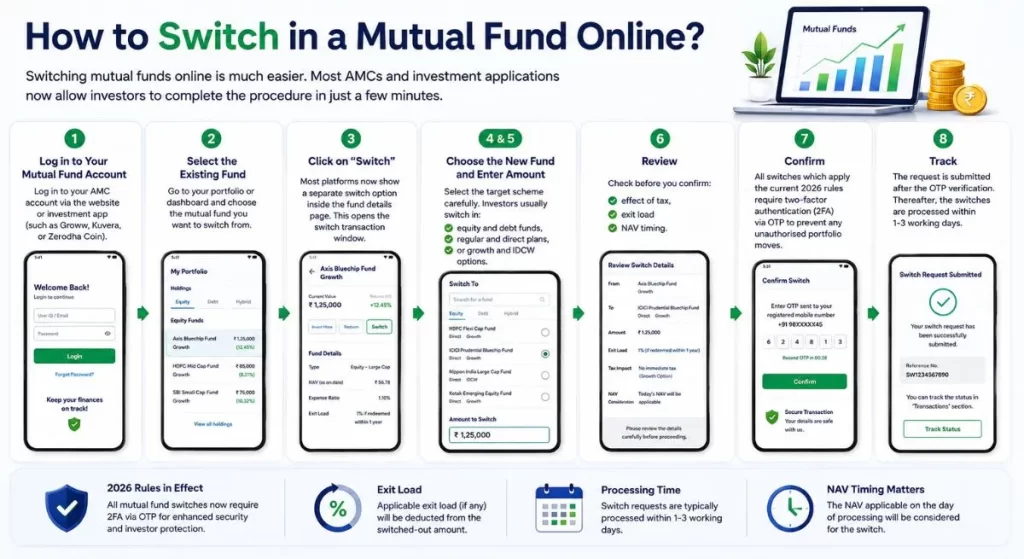
Switching mutual funds online is much easier. Most AMCs and investment applications now allow investors to complete the procedure in just a few minutes.
Step 1: Log in to Your Mutual Fund Account
Log in to your AMC account via the website or investment app (such as Groww, Kuvera, or Zerodha Coin).
Step 2: Select the Existing Fund
Go to your portfolio or dashboard and choose the mutual fund you want to switch from.
Step 3: Click on “Switch”
Most platforms now show a separate switch option inside the fund details page. This opens the switch transaction window.
Step 4 & 5: Choose the New Fund and Enter Amount
Select the target scheme carefully. Investors usually switch in:
- equity and debt funds,
- regular and direct plans,
- or growth and IDCW options.
Step 6 to 8: Review, Confirm, and Track
Check before you confirm:
- effect of tax,
- exit load
- NAV timing.
All switches which apply the current 2026 rules require two-factor authentication (2FA) via OTP to prevent any unauthorised portfolio moves. The request is submitted after the OTP verification. Thereafter, the switches are processed within 1-3 working days.
What is The Offline Process to Switch in a Mutual Fund?
There’s also an offline process to switch into a mutual fund. The investors who prefer offline methods can visit the AMC branch or contact a financial expert. A switch request form needs to be filled out with:
- Folio number,
- PAN details
- and KYC information.
The process can take a bit of time, but many investors still prefer personal assistance while making portfolio changes.
Tax Impact of Switch in Mutual Fund in 2026
A mutual fund switch is treated as a taxable event because it is considered a redemption first and a fresh investment later.
For equities mutual funds:
- Gains on units sold before 12 months are taxed as short-term capital gains at 20%.
- If you make gains of more than Rs 1.25 lakh after 12 months, they would be taxed at 12.5%.
Debt funds now follow different rules. For investments made after April 2023, gains are usually taxed according to the investor’s income tax slab, regardless of the holding period.
This is why many investors now prefer tax-efficient mutual fund switching instead of switching randomly. Some even spread switches across different financial years to reduce taxable gains and avoid a bigger tax hit in one go.
Expert Insight from Finvest India: Don’t change just because an influencer changed their mind in a volatile 2026 market. Change because your phase of life shifted. If you’re three years away from a goal, say buying a house, moving from Equity to Debt is a defensive move, not a market timing move.
Important Things to Check Before a Mutual Fund Switch
Before confirming a mutual fund switch, stop and check these few important points. A small mistake here can lead to taxes, delays, or extra charges later.
- Same AMC or different AMC? Direct switching normally only works between the same AMC. SBI Mutual Fund to HDFC Mutual Fund cannot be directly switched without redemption.
- Is it an ELSS fund? ELSS investments come with a 3-year lock-in period. Units under lock-in cannot be switched out.
- What is the mutual fund NAV cut-off timing? Requests that are submitted before the cut-off time, usually 3:00 PM, may get the same day’s NAV.
- Is exit load applicable? Many schemes charge around 1% exit load if units are switched within 365 days.
If you want a better idea before making your investment decisions, Finvest India’s financial assessment services in Bangalore can help you evaluate your portfolio more effectively.
Common Mistakes to Avoid While Switching Mutual Funds
Many investors switch funds too quickly and regret it later. One market correction does not mean the fund has failed.
Some common mistakes include:
- Panic switching during market falls.
- Chasing last year’s top-performing fund.
- Ignoring tax on mutual fund switch and exit load.
- Changing funds too frequently without a proper reason.
Repeated switching also interrupts your compounding, which is where real wealth usually gets built. A mutual fund switch should happen because your financial needs have changed, not because the market made you nervous for a few weeks.
Final Thoughts on Choosing the Right Switch in a Mutual Fund
A switch in a mutual fund should solve a problem, not create a new one. Many investors switch funds because of panic, market noise, or short-term returns, and later realize they ignored taxes, exit loads, or even their actual financial goals. Sometimes the better decision is not switching at all. What matters is understanding why you’re making the move in the first place.
If you’re trying to understand mutual funds in a simpler and more practical way, Finvest India shares insights that help investors make more informed decisions without making investing sound confusing or overwhelming.
Need Help Deciding Whether to Switch Your Mutual Funds?
FAQ's Related To Switch In Mutual Fund
Switching is usually more convenient when you want to move money between schemes within the same AMC. But from a tax perspective, both switching and redeeming are treated similarly.
Yes, but you normally need to terminate the old SIP first. Then you can start a new SIP in the mutual fund plan of your choice.
Yes. Investors these days are preferring direct plans to cut expense ratios and boost long-term returns. But the switch could still attract a capital gains tax.
There is normally no separate changeover fee, but exit load and taxes may apply depending on the type of investment and the holding period.