

Bangalore’s high rent, big deposits, and fast-moving job market make standard money advice fall short. Young professionals here need five habits: budget around actual take-home pay, build a 6-9 month emergency fund, start a SIP early, choose a tax regime deliberately, and get personal health and term insurance instead of relying on employer cover alone.
Take Arjun. He started his first job in Bangalore. His salary looked great, and he thought saving would be easy. But a few months in, he was broke. A big security deposit, high rent, food deliveries, cab rides, weekend outings. It all added up fast.
It took him a few months to understand what was going wrong. Bangalore was simply more expensive than he had expected. Once he started planning ahead instead of spending as he went, he finally felt like he was in control of his money.
If you’re beginning your career in the city, developing strong financial habits for young professionals in Bangalore from day one can help you avoid the same costly mistakes and build long-term financial security.
Table of Contents
Common Budgeting Mistakes Young Professionals Make in Bangalore
1. Budgeting based on your CTC instead of your take-home salary.
Your monthly expenses should always be planned around the amount that reaches your bank account.
2. Underestimating rental costs.
Deposits, brokerage, and moving expenses hit all at once, and Bangalore makes this worse than most cities.
3. Increasing lifestyle expenses after every salary hike.
Instead of spending every raise, consider increasing your SIP or emergency fund contribution first.
4. Ignoring irregular annual expenses.
Insurance premiums, travel, festivals, and vehicle maintenance should be factored into your budget.
5. Not tracking monthly spending.
Food delivery, cabs, and subscriptions feel small one at a time. Added up over a year, they quietly eat into your savings.
Many first-time professionals focus on their monthly rent but overlook one-time costs such as rental deposits, brokerage, and relocation expenses. Planning for these costs in advance can make the transition to Bangalore much smoother.
Why Bangalore needs different financial habits for young Adults?
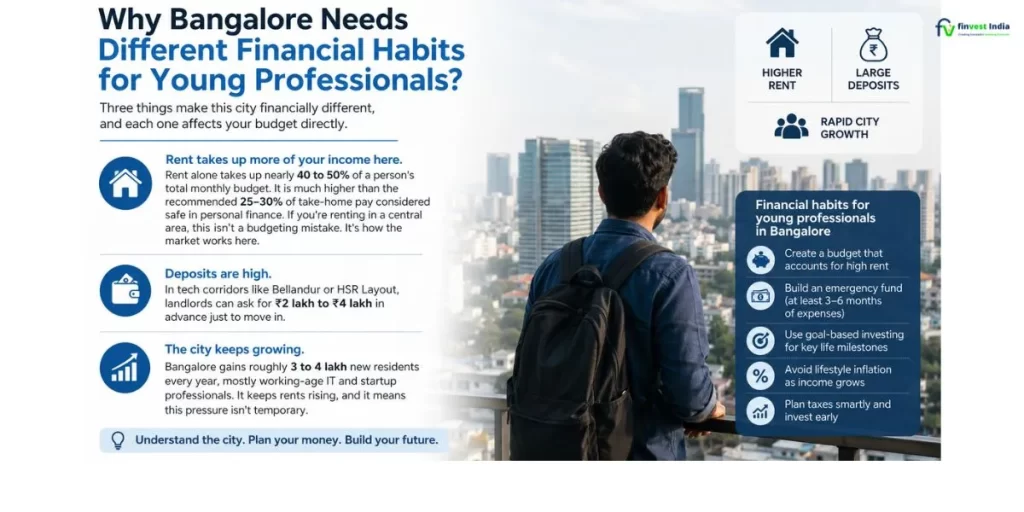
Three things make this city financially different, and each one affects your budget directly.
1. Rent takes up more of your income here.
Rent alone takes up nearly 40 to 50% of a person’s total monthly budget. It is much higher than the recommended 25–30% of take-home pay considered safe in personal finance. If you’re renting in a central area, this isn’t a budgeting mistake. It’s how the market works here.
2. Deposits are high.
In tech corridors like Bellandur or HSR Layout, landlords can ask for ₹2 lakh to ₹4 lakh in advance just to move in.
3. The city keeps growing.
Bangalore gains roughly 3 to 4 lakh new residents every year, mostly working-age IT and startup professionals. It keeps rents rising, and it means this pressure isn’t temporary.
Here are some financial habits for young professionals in Bangalore when you’re building a career in this specific city.
1. Budget around Bangalore's rent
You’ve probably heard of the 50-30-20 rule. Half your income goes to needs, 30% to wants, 20% to savings. It works well on paper. The problem starts when you try to fit Bangalore rent into that 30% slice. For most people here, it just doesn’t.
Here’s what rent looks like across the city’s major localities:
| Locality | Typical 1 BHK Rent per Month |
|---|---|
| HSR Layout | ₹25,000 – ₹35,000 |
| Whitefield | ₹25,000 – ₹35,000 |
| Indiranagar | ₹25,000 – ₹35,000 |
| Koramangala | ₹20,000 – ₹35,000 |
| Electronic City | ₹14,000 – ₹26,000 |
| Yelahanka | ₹14,000 – ₹26,000 |
| BTM Layout (PG/shared options included) | ₹8,000 – ₹19,000 |
Two habits help here:
- Try to keep rent under 30% of your take-home pay. If you’re above that, treat it as a deliberate choice
- Save for your deposit and brokerage separately from your monthly budget. These costs are high but predictable
2. Size your emergency fund for Bangalore's job market
Standard advice suggests 3 to 6 months of expenses in an emergency fund. In Bangalore, it’s better to aim higher, closer to 6 to 9 months, for two reasons:
Firstly, the tech and startup job market moves quickly, and your next rental deposit alone could cost ₹2 to 4 lakh.
Keep this fund somewhere liquid, such as a savings account, a sweep-in fixed deposit, or a liquid mutual fund, rather than somewhere you’d lose money by withdrawing early.
Many people think an emergency fund is only for job loss. But in Bangalore, it’s also useful when you’re changing jobs or moving to a new area. You’ll often need to pay a new rental deposit before you receive your first salary, so having savings helps you manage this expense without financial stress.
3. Start a SIP and automate it
Think of a SIP (A Systematic Investment Plan) as a piggy bank you add to every month, instead of putting all your money in at once. In Bangalore, many people work in tech, and they change jobs quite often. Each time they do, they usually earn a little more than before.The easiest way to make sure that increase turns into savings is to raise your SIP amount at the same time your salary changes. The easiest way to make sure that increase turns into savings is to raise your SIP amount at the same time your salary changes.
If you’re not sure where to start, AMFI’s investor education platform, Mutual Funds Sahi Hai, is a good place to learn how SIPs work, understand different types of mutual funds, and build a foundation before investing.
4. Choose your tax regime deliberately
India’s new tax regime is now the default option for salaried employees. Many people simply accept the default their employer applies. This matters more in Bangalore than in most cities for one specific reason: HRA, or House Rent Allowance, exemption is only available under the old tax regime.
Before assuming the new regime is automatically better, calculate your tax under both regimes using your actual salary structure. You can find official details on both regimes on the Income Tax Department’s website. If you’re looking to reduce your overall tax burden, read our guide on 6 Benefits of Tax Planning in India for 2026 to learn practical tax-saving strategies.
5.Get term and health insurance before anything else
Many employers in Bangalore’s IT and startup sector provide group health insurance. But this cover ends the day you resign. Since job changes are common here, a personal health insurance policy and a basic term insurance plan cover the gap between jobs, so a career move doesn’t leave you uninsured, even temporarily.
What is Karnataka's professional tax?
In Karnataka, there’s a ₹2,500-a-year deduction from your taxable salary under Section 16(iii) of the Income Tax Act, whichever regime you’re on. It is that most young professionals in Bangalore never look up. It’s called professional tax, a small state-level tax separate from income tax, and it’s easy to miss because it’s so small compared to everything else coming out of your salary.
Anyone earning ₹25,000 or more a month pays ₹200 as professional tax for 11 months of the year, and ₹300 in February, adding up to ₹2,500 a year.
If you’re earning below ₹25,000 a month, you’re exempt entirely.
What your CTC actually means?
Your CTC, or Cost to Company, is the number on your offer letter. It is not the same as your monthly take-home salary, and the gap matters more in Bangalore because tech and startup pay structures include a larger share of components that don’t reach your bank account as fixed monthly cash.
Here’s what’s actually inside a typical CTC, based on statutory rules:
| CTC Component | What It Actually Is | When You See the Money |
|---|---|---|
| Basic Salary + HRA + Special Allowance | Your fixed monthly salary components that make up your regular pay. | Every month, credited to your bank account. |
| Employee EPF Contribution | 12% of your Basic Salary + Dearness Allowance (DA), deducted from your salary and contributed to the Employees’ Provident Fund (EPF). | Credited to your EPF account every month, not your bank account. |
| Employer EPF Contribution | Employer contributes 12% of Basic Salary + DA, with 3.67% going to EPF and 8.33% to the Employees’ Pension Scheme (EPS). | Included in your CTC but not paid as part of your monthly take-home salary. |
| Gratuity | A lump-sum retirement benefit payable under the Payment of Gratuity Act, 1972. | Payable only if you complete at least 5 years of continuous service with the employer. |
| Variable / Performance Pay | Performance-linked bonus based on achieving predefined goals or targets. | Paid only if performance targets are met, typically quarterly or annually. |
Two job offers with the same CTC can differ by ₹8,000–₹10,000 in actual monthly take-home, depending on how much is allocated to EPF, gratuity, and variable pay versus fixed cash. Before accepting an offer, ask HR for a salary breakup sheet, so you’re comparing what actually lands in your account each month.
How Employer NPS Contributions Improve Financial Habits for Young Adults in Bangalore?
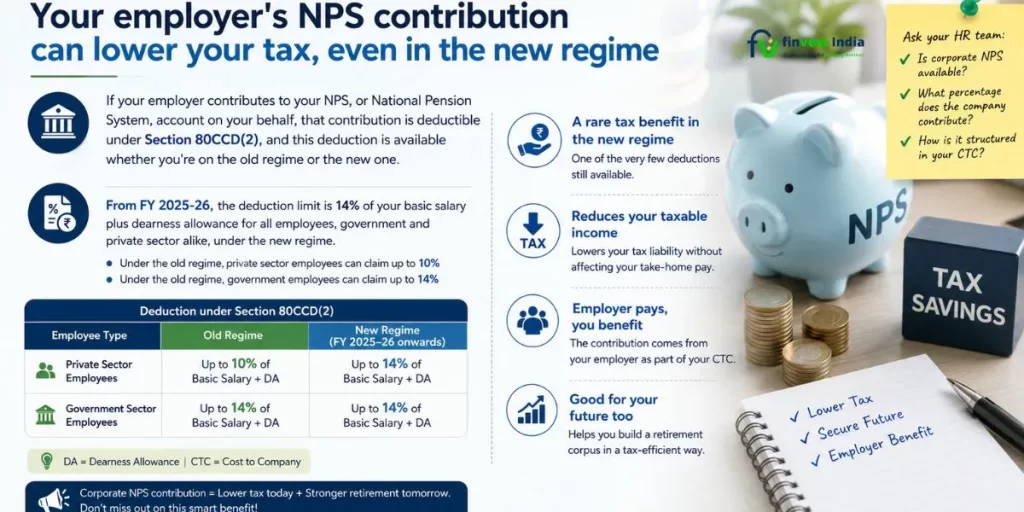
If your employer contributes to your NPS, or National Pension System, account on your behalf, that contribution is deductible under Section 80CCD(2), and this deduction is available whether you’re on the old regime or the new one.
From FY 2025-26, the deduction limit is 14% of your basic salary plus dearness allowance for all employees, government and private sector alike, under the new regime. Under the old regime, private sector employees can claim up to 10%, while government employees can claim up to 14%.
If your employer offers a corporate NPS benefit, this is one of the very few deductions the new regime still allows, and it doesn’t reduce your take-home pay the way a personal SIP does. This is because the contribution comes from your employer as part of your CTC. It’s worth asking your HR team whether this benefit is available and at what percentage.
Financial Habits for Young Adults in Bangalore: Key Takeaways
Developing good financial habits for young professionals in Bangalore means you may have to manage your money a little differently. That doesn’t mean the city is unaffordable.
Budget for the actual cost of rent, keep enough money aside for emergencies, start investing early before your expenses grow, choose the tax regime that saves you more, don’t depend only on your employer’s insurance, and take a few minutes to understand your payslip.
Small financial habits like these can make living in Bangalore much easier.
Before making major financial decisions, it helps to understand your current financial position. Our Financial Assessment Service in Bangalore provides a detailed review of your income, expenses, investments, insurance, and financial goals to help you build a stronger financial future.
Disclaimer: This article is for general informational purposes and does not constitute investment, tax, or legal advice.