
How Risk Profiling in Financial Assessment Helps Bangalore Investors Make Smarter Decisions?
Last year, Rohit thought he was doing everything right. He had a good job at a Bangalore startup, decent savings, and friends constantly talking about stocks and mutual funds during lunch breaks. So he started investing too. Without really understanding risk profiling in financial assessment, he kept putting money into whatever looked promising at the moment. Small-cap funds, trending stocks, and even a few risky bets people online were calling “the future.”
Then markets turned shaky. The same investments that looked exciting suddenly became stressful. Rohit started checking his portfolio every few hours. He paused his SIPs, sold a few stocks in panic, and realized something most investors learn the hard way: Earning well does not automatically mean you can handle high investment risk.
And honestly, this is happening across Bangalore right now. A shocking 64% of market investors engaging in India, in the SEBI Investor Survey, operate with little or no knowledge of the actual product risks.
People are investing faster than ever, but many still don’t know whether their investments actually match their financial situation, responsibilities, or comfort with risk. That’s where proper risk profiling starts making a real difference. In this blog, we’ll look at why it matters, how it works, and why Bangalore investors need to take it seriously in 2026.
Table of Contents
What Is Risk Profiling in Financial Assessment?
In simple terms, risk profiling means understanding how comfortable and financially capable a person is when it comes to taking investment risks.
It sounds technical, but honestly, it’s mostly about understanding people properly before advising them where to invest.
A proper financial assessment usually looks at things like:
- Income
- Savings
- Loans
- Future responsibilities
- Investment goals
- Market experience
- Emotional behaviour during losses
The last point is very important. Many investors believe they are comfortable with market risk because they’ve only seen markets going up. But when an actual correction happens, reactions change fast.
Suddenly, the same person who wanted “aggressive growth” starts worrying after a 10% fall.
That’s where financial risk profiling becomes useful. It helps investors build portfolios they can realistically stay invested in, not portfolios that only look exciting during bull markets.
Why Risk Profiling in Financial Assessment Matters More Than Ever for Bangalore Investors?
Bangalore has become one of India’s biggest investment hubs. The city has high-income professionals, startup wealth, tech employees, founders, consultants, and a huge number of first-generation investors. Naturally, more money is flowing into equity markets now.
But Bangalore also has its own financial pressures.
A person may earn ₹30 lakh a year and still feel financially stretched. There are rent or home EMIs, lifestyle spending, school fees, family responsibilities, travel, rising living costs, and sometimes, startup job uncertainty sitting quietly in the background.
Still, many investors assume, “A good salary means I can take a high risk.” That’s not true.
Somebody working in a startup with ESOP-heavy compensation already has indirect exposure to market risk. If the company struggles, both income and wealth creation can be affected together.
That’s why proper investor risk assessment matters.
Why Following Internet Investment Advice Can Increase Financial Risk?
One big reason risk profiling has become important in 2026 is that everybody is consuming financial content daily. And honestly, a lot of it makes investing look simpler than it actually is.
You’ll see someone online talking about turning ₹2 lakh into ₹20 lakh through aggressive investing. Another person pushes small-cap stocks like they’re guaranteed winners. Someone else says debt funds are useless because “equity gives better returns.”
But finance doesn’t work the same way for everyone. People copy each other constantly. That’s where the problems start.
Without proper risk assessment in financial planning, investing slowly turns emotional. The decisions get driven by hype, fear, and comparison instead of logic.
Expert Insight: Sleek digital apps make market access rapid, but they hide danger totally. A comprehensive SEBI analysis says the grim reality is: 91% retail individual traders in India are net losers, aggregate retail loss increasing to ₹1.8 Lakh Crore. Without a full risk profile, you are simply betting against institutional algorithms rather than investing wisely.
What Financial Experts Look At During Risk Profiling in Financial Assessment?
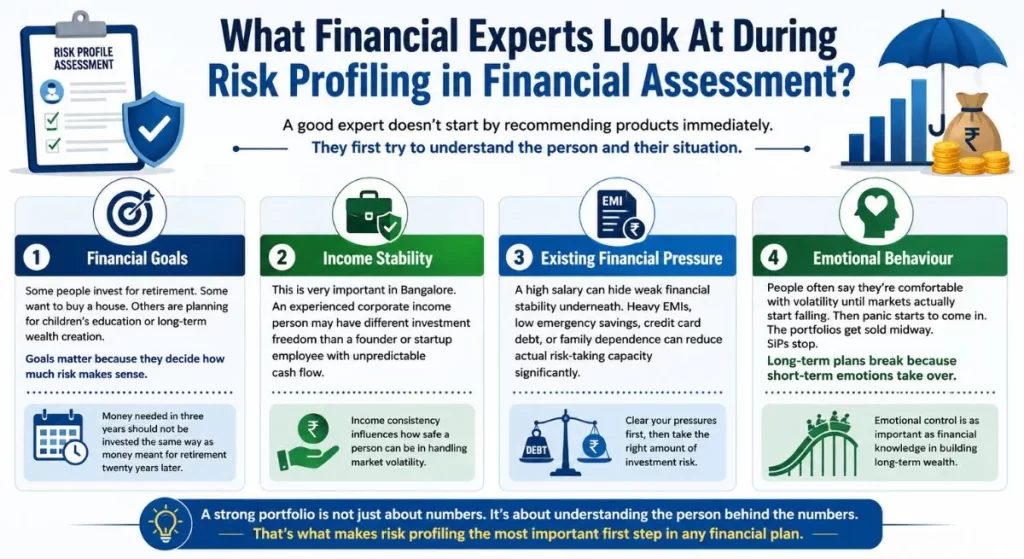
A good expert doesn’t start by recommending products immediately. They first try to understand the person and their situation.
Financial Goals
Some people invest for retirement. Some want to buy a house. Others are planning for children’s education or long-term wealth creation. Goals matter because they decide how much risk makes sense.
Money needed in three years should not be invested the same way as money meant for retirement twenty years later.
Income Stability
This is very important in Bangalore. An experienced corporate income person may have different investment freedom than a founder or startup employee with unpredictable cash flow. Income consistency influences how safe a person can be in handling market volatility.
Existing Financial Pressure
A high salary can hide weak financial stability underneath. Heavy EMIs, low emergency savings, credit card debt, or family dependence can reduce actual risk-taking capacity significantly.
Emotional Behaviour
People often say they’re comfortable with volatility until markets actually start falling. Then panic starts to come in. The portfolios get sold midway. SIPs stop. Long-term plans break because short-term emotions take over.
How Risk Profiling in Financial Assessment Helps Build Better Investment Decisions?
The real benefit of risk profiling in financial assessment is balance. Not playing too safe. Not taking unnecessary risks either. Just investing in a way that actually fits your life.
A 26-year-old tech employee may prefer more equity for long-term growth. But at the same time, that person still needs emergency savings because layoffs and hiring freezes are common now.
A mid-career professional typically needs a better balance of growth and security, as their responsibilities rise with time.
Someone who’s going to retire often focuses more on:
- protecting savings,
- regular income,
- lower volatility.
For retirees and those nearing retirement, understanding how risk tolerance affects investment choices is crucial. Read How to Choose the Right After Retirement Investment Plans Based on Risk Profile to learn how different risk profiles influence retirement investment decisions.
That is where proper portfolio management in Bangalore matters. Investments should match:
- financial goals,
- age,
- responsibilities,
- emotional comfort with risk.
Not whatever trend is dominating the market that month.
Choosing the Right Financial Assessment Partner in Bangalore

Finding the right personalised investment planning in Bangalore is not really about choosing the firm with the biggest promises. It is more about finding someone who understands how your financial life actually works.
A startup employee with ESOPs will have different concerns compared to a business owner or someone planning retirement. That’s why generic investment advice usually doesn’t help much anymore.
A good financial assessment partner should help you understand:
- How much risk makes sense for you.
- Where your money is overexposed.
- Whether your investments match your real goals.
They should also explain things clearly instead of making finance sound difficult. That is one reason many investors now prefer financial assessment services in Bangalore that focus on practical, personalised financial planning.
To better understand how professionals uncover weaknesses in a portfolio, read How Financial Assessment Services Help Identify Investment Gaps.
Can Technology Replace Human Advice in Wealth Management in 2026?
Technology is changing how investors approach financial planning in 2026. According to PwC’s Global Asset and Wealth Management Research, leading wealth firms are actively embracing hyper-personalization, data analytics, and AI models to pinpoint risk signals and customize portfolios at scale. They now use AI tools to study:
- spending habits,
- investment behaviour,
- portfolio exposure,
- risk patterns.
Robo-advisory platforms are also becoming popular because younger investors prefer fast and simple digital analysis. But technology still has limits.
- An algorithm can tell you your risk capacity in seconds in math.
- But an algorithm can’t hold your hand or calm your nerves when the market loses 15%, and fear sets in.
That is why experienced advisors continue playing an important role in modern wealth management strategies.
60-Second Financial Risk Check for Bangalore Investors
Before putting more money into stocks, SIPs, or trending investments, pause for a minute and ask yourself a few honest questions.
- Does your income depend heavily on tech or startups, while your portfolio is also filled with IT funds or US tech stocks? That kind of sector overlap can be dangerous in slowdowns.
- Is your pay being eaten up by high rents or premium EMIs in localities like Whitefield, even though your CTC appears okay on paper?
- Is your liquid emergency fund sitting below six months of actual monthly expenses?
- Did you invest in something mainly because of a trending social media reel, online hype, or peer pressure instead of a proper financial goal?
If even two of these feel familiar to you, your portfolio may be carrying more risk than you realize.
Why Risk Profiling in Financial Assessment Matters for Bangalore Investors?
In the end, risk profiling in financial assessment is not about making investing complicated. It is about making it fit in real life. For Bangalore investors, that means looking at income, goals, pressure, and comfort with ups and downs before choosing where to put money. When that part is clear, decisions become calmer and more practical.
That is the kind of approach Finvest India supports through thoughtful financial planning. In the long run, the right plan is usually not the loudest one. It is the one that suits the investor properly.
Get Your Risk Profile Assessed Today
FAQs Related to Risk Profiling in Financial Assessment
If you’re investing through a financial advisor, some level of risk assessment is usually done before products are recommended. SEBI expects advisors to understand whether an investment actually suits the investor instead of giving random suggestions.
No. KYC is just basic verification, your PAN, identity, address proof, and other documents. Risk profiling is more personal. It looks at your financial life, future plans, and spending pressure and comfort with market ups and downs.
Usually, once a year is a good idea. But major life changes matter more; things like marriage, switching jobs, having children, starting a business, or even a big salary jump can change your financial comfort level.
No, because life doesn’t stay the same. The kind of risk you could handle at 25 may feel completely different at 40. Your investments should grow and adjust along with your responsibilities and financial goals.