

Imagine you’ve been working abroad for a while. You’ve saved up some money, and now you’re thinking, “Why not invest in India?”
So you start looking into it. Different rules, tax confusion, currency conversion questions, and a long list of investment options you’re not even sure how to compare. At some point, most people just pause and think, there has to be an easier way to do this.
That’s exactly where GIFT City investment for NRIs starts to make sense. GIFT City was set up to simplify cross-border investing for NRIs by bringing everything into one regulated financial hub. You get access to global-style investment products, can deal in foreign currency, and operate under a framework that’s designed specifically for international investors. In simple terms, it’s meant to remove a lot of the friction that usually comes with investing back home.
In this blog, we’ll break it down: what GIFT City actually is, who can invest, what kind of options you get, the tax benefits, the basic rules you should know, the risks involved, and how you can actually get started without feeling overwhelmed.
Table of Contents
What is GIFT City?
GIFT City (Gujarat International Finance Tec-City) is India’s first operational International Financial Services Centre, or IFSC. It’s located in Gandhinagar, Gujarat, and was created with a very specific idea in mind. To bring global financial services into India in a way that feels familiar to international investors.
Inside this zone, you’ll find banking, insurance, stock trading, fund management, and other financial services, all operating under a more globally aligned framework.
Everything in GIFT City is regulated by the International Financial Services Centres Authority (IFSCA).
GIFT City’s repute goes beyond domestic issues. GIFT City-Gandhinagar rose three spots to 43rd in the Global Financial Centers Index (GFCI 38), issued by UK think tank Long Finance/Z-Yen twice a year. Although lower than most tax incentives, it’s a useful external checkpoint: independent assessors, not simply Indian advertising material, are tracking GIFT City’s financial integrity.
Another thing that stands out is currency. Investments are often offered in foreign currencies such as the US dollar. This is very excellent news for NRIs since it means they would not have to keep changing their money back and forth between the countries.
GIFT City in 2026: What Has Changed?
If you read about GIFT City a year or two ago, a few things have moved since. Diaspora investment into GIFT City’s fund ecosystem has now crossed USD 7 billion, per IFSCA’s own chairman, and GIFT City itself climbed to 43rd in the latest Global Financial Centres Index. On the rules side, IFSCA rolled out video KYC (V-CIP) for NRIs in select countries, so opening an account no longer always means a trip to India.
The product shelf has widened too; more mutual funds, AIFs, and PMS options are live, with entry points ranging from a few thousand dollars for retail mutual funds up to $75,000+ for AIFs. NRI eligibility remains open to NRIs, OCIs, and foreign investors, and Budget 2026 has floated easier equity access, though that part isn’t finalised yet.
Who Can Invest in The GIFT City?
A lot of people assume GIFT City is only for large institutions or ultra-wealthy investors. That’s not really true anymore.
Today, NRI investment in GIFT City is open to a fairly wide group of investors, as long as they meet basic regulatory requirements. In most cases, eligible investors include:
- Non-Resident Indians (NRIs).
- Overseas Citizens of India (OCIs).
- Foreign individuals.
- Foreign companies.
- Family offices.
- Institutional investors and eligible funds.
IFSCA has issued specific guidance on this exact point; see its official notification on Facilitating investments by NRIs and OCIs into Indian securities through Schemes/Funds in an IFSC (IFSCA Legal Framework, May 2024), which sets out how NRI and OCI money can flow into IFSC-based schemes.
Why Gift City Investment for NRIs Is Growing in 2026 ?
The interest in GIFT City investment hasn’t happened overnight. It has been building steadily, and 2026 has only accelerated that trend.
- A big reason is long-term government backing. GIFT City isn’t a short-term project; it’s a part of India’s plan to position itself as a global financial hub. This means long-term policy support, infrastructural development, and improved regulation. The numbers support it. The Indian diaspora has invested USD 7 billion in GIFT City-based funds, according to IFSCA officials at a public event and Business Standard. That’s not a projection, it’s money that’s already moved.
- Another major factor is the ecosystem itself. A few years ago, options were limited. Today, you have international banks, global fund houses, insurance companies, and wealth managers operating from the IFSC.
- Digital onboarding has also changed the game. Earlier, investing from abroad often meant paperwork, physical signatures, and long waiting periods. Now, most of it is online. For NRIs, that convenience matters a lot.
- There’s also a bigger shift happening in investor behaviour. More NRIs are actively looking for global diversification, not just investing in one country or one currency. GIFT City fits into that mindset because it allows exposure to multiple markets through a single regulated platform.
- And finally, the entry of global financial institutions has added credibility. When well-known international players participate, it naturally increases confidence among individual investors as well.
Eligible GIFT City Investment Options for NRIs
One of the most interesting things about IFSC investment for NRIs is the range of options available.
Investment | Risk | Return Potential | Suitable For |
Stocks | High | High | Long-term growth investors. |
ETFs | Moderate | Moderate to High | Diversified investing |
GIFT City mutual funds | Moderate | Moderate | Long-term wealth creation. |
Bonds | Low to Moderate | Stable | Conservative investors. |
REITs & InvITs | Moderate | Moderate | Income-focused investors. |
AIFs | High | High | Experienced investors. |
PMS | Moderate to High | High | High-net-worth individuals. |
1. Stocks on IFSC Exchanges
You can invest in securities listed on exchanges operating within GIFT City. These may include Indian and international exposure depending on the listing.
Stocks are usually chosen by investors who are comfortable with volatility and are investing for the long term.
2. Exchange Traded Funds (ETFs)
ETFs are often seen as a “middle ground” investment.
You invest in a basket of assets that track an index or sector, rather than buying individual equities. It’s easy, diversified and generally more cost-effective than actively managed funds.
For many NRIs, ETFs are an easy method to acquire market exposure without having to check specific firms regularly.
3. GIFT City Mutual Funds
For people who prefer a more hands-off approach, GIFT City mutual funds are often the go-to option.
Here, your money is looked after by expert fund managers who select where to invest it in line with the fund’s aim. You can opt for equity funds, debt funds, hybrid funds or even international-focused funds.
4. Bonds and Fixed Income Instruments
If you want something more stable than high returns, you might want to consider bonds.
They usually offer a steady income and less volatility than stocks. They may not be rapid growth stocks but they do help balance out risk in a portfolio.
5. REITs, AIFs and PMS
REITs & InvITs allow you to invest in real estate and infrastructure without the hassle of buying the property. Depending on the structure you get income from rent or project cash flows.
AIFs are more specialized. They tend to invest in private equity, start-ups or alternative tactics. These are often high risk and not for novices.
The PMS (Portfolio Management Services) is personalized. In PMS, a professional manager will create and manage a portfolio according to your needs. This is typically used by high-net-worth investors who want a more tailored approach.
What Are The Tax Benefits of GIFT City Investments for NRIs?
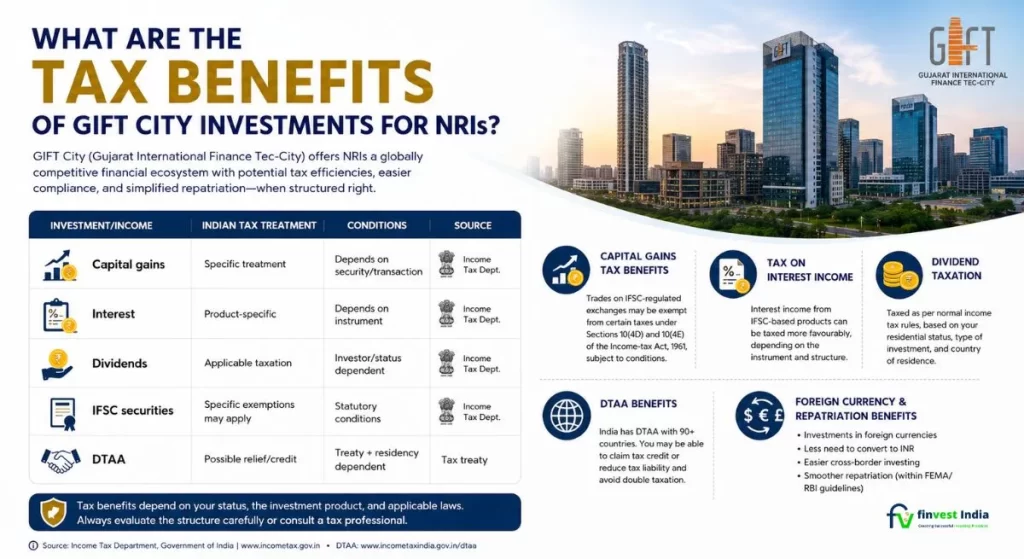
A big reason NRIs are even looking at GIFT City in the first place is simple: the tax setup can be more efficient in certain cases. That’s one of the key attractions behind GIFT City investment for NRIs.
Investment/Income | Indian Tax Treatment | Conditions | Source |
Capital gains | Specific treatment | Depends on security/transaction | |
Interest | Product-specific | Depends on instrument | Income Tax Dept. |
Dividends | Applicable taxation | Investor/status dependent | Income Tax Dept. |
IFSC securities | Specific exemptions may apply | Statutory conditions | Income Tax Dept. |
DTAA | Possible relief/credit | Treaty + residency dependent | Tax treaty |
1. Capital Gains Tax Benefits
Some investments routed through IFSC may get better capital gains treatment, but this is not automatic.
Under Indian tax law, trades on IFSC-regulated exchanges may be free from some taxes. The government explains its position in the Income Tax Act Non-residents and certain funds are exempt from certain income on IFSC-listed shares and offshore derivative instruments under Sections 10(4D) and 10(4E) of the Income-tax Act, 1961.
2. Tax on Interest Income
Interest income from IFSC-based products can sometimes be taxed more favourably, but again, it depends on the structure.
A bond issued by one institution may be treated differently from another. So instead of assuming “IFSC = tax-free or low tax,” it’s better to look at the product details carefully.
3. Dividend Taxation
Dividends are taxed based on normal income tax rules. What you pay depends on:
- Your residential status.
- The type of investment.
- The country you live in.
4. DTAA Benefits
This is where tax benefits for NRIs under DTAA come in.
India has Double Taxation Avoidance Agreements with more than 90 nations to ensure that you do not end up paying tax twice for the same income. The Income Tax Department has published the full official list of India’s DTAA partner countries and the treaty texts itself. In simple terms, you may be able to:
- Claim a tax credit in your resident country, or
- Reduce tax liability depending on the treaty.
5. Foreign Currency & Repatriation Benefits
One of the more useful benefits of GIFT City is the flexibility of currencies. Many investments are listed in foreign currencies, which means:
- Sometimes you don’t have to convert money to INR.
- It is easier to invest across borders.
- Cross-border investing becomes smoother.
- Repatriation is often simpler (within FEMA/RBI rules).
How to Open an IFSC Investment Account?
If you’re wondering about how to open an IFSC account, the good news is it can be done online.
Step 1: Choose an IFSC Bank or Broker
Start with an IFSCA-regulated broker, bank, or investment platform. Be patient with this step. Compare with:
- Charges
- Range of products
- Customer Support
- Ease of Use
Step 2: Complete KYC
Like any financial account, you’ll need to complete KYC. This is merely regular identification verification and compliance checks.
Step 3: Submission of Documents
Generally, you’ll be asked for:
- Passport PAN (if applicable)
- Proof of residency or visa
- Proof of overseas address
- Passport Photo
- FATCA/CRS declaration form
- Foreign Bank Account Information
Expert Insight: The single most common gap we see isn’t on the Indian side, GIFT City’s rules and exemptions are reasonably well documented. It’s the resident-country reporting (FBAR/FATCA-style disclosures, remittance-basis elections, foreign tax credit claims) that gets treated as a “deal with it later” item. Build this into your plan from the time of investing, with your home-country tax advisor involved from the start, not at the time of filing.
Step 4: Account Opening
After all are verified, your IFSC account is activated. This typically takes a few days, perhaps a number of weeks.
Step 5: Deposit Money to Your Account
You can now send money in allowed foreign currency. Just make sure you know the minimum investment required before transferring funds.
Step 6: Start Investing
When you have the money you can invest it in:
- Funds, mutual
- ETFs
- Bonds Equities
- Portfolio management service
RBI, FEMA & IFSCA Regulations Every NRI Should Know
Before investing, let’s understand the basic regulatory setup.
- RBI: This is the site for banking and foreign currency rules. It contains the Master Directions for NRE, NRO and FCNR accounts.
- IFSCA is the single regulator for financial services within GIFT City, including banking, capital markets, insurance and fund management within the IFSC.
- FEMA (the Foreign Exchange Management Act, 1999, managed jointly by RBI and the government) rules the flow of money across the border.
These three together determine how your money is moved, what you can invest in, and how repatriation occurs. GIFT City is supposed to be more global and adaptable but will not be outside the regulatory framework of India.
Also, don’t forget about tax reporting in your country of residence. This is where most NRIs are caught off guard, an investment being tax effective in India does not indicate it will be tax efficient (or even properly stated) in your country of residence.
Key Risks Every NRI Should Know Before Investing in GIFT City
Let’s be real, no investment is risk-free.
- Market Risk: Prices go up and down. That’s the way markets work.
- Currency Risk: Many of the investments are in foreign currency, and fluctuations in the exchange rate can affect results.
- Liquidity Risk: Some items may not be easy to close out quickly, especially under rough market conditions.
- Regulatory Risk: Rules can change. This includes investment and tax limits.
- Product Risk: Not all investments carry the same level of risk. A bond is very different from an AIF or equity fund.
Gift City Investment Readiness Checklist for NRIs
Before you fund a GIFT City account, it’s worth running through this list. It catches most of the delays and mismatches NRIs run into in practice:
- Confirmed your current residency and tax-residency status (these aren’t always the same thing).
- Checked whether your country of residence is currently on IFSCA’s V-CIP-eligible list, or whether you’ll need an alternate KYC route.
- Identified which DTAA article applies to the type of income you expect (capital gains vs. interest vs. dividends are often treated differently).
- Shortlisted 2-3 IFSCA-regulated banks/brokers and compared minimum investment thresholds for your product of interest.
- Gathered passport, PAN, overseas address proof, and FATCA/CRS declaration in advance.
- Decided how much currency risk you’re comfortable holding (GIFT City doesn’t eliminate it, it just changes where you hold it).
- Planned how repatriated or reinvested income will be reported in your country of residence.
- Set a review point (6-12 months)
GIFT City vs Investing Directly in India
This is a question almost every NRI asks.
Feature | GIFT City | Direct India Investing |
Currency | Mostly foreign currency | Indian rupee |
Product access | Global + domestic mix | Mostly domestic |
Global exposure | Higher | Limited |
Repatriation | More streamlined | More restrictions |
Regulation | IFSCA | RBI + SEBI |
Ease of access | Digital-first | Depends on platform |
So which one is better?
Honestly, it depends.
- If you want global exposure and currency flexibility → GIFT City makes sense
- If you want India-focused investing → traditional routes still work well
In practice, the NRIs who get the most value from GIFT City are the ones who start with “what portfolio makes sense for my goals and risk appetite” and then check where GIFT City fits in, not the other way around. When tax efficiency is the entire pitch, the underlying product quality, fund manager track record, and liquidity terms often get skipped over, and those are the things that actually determine your outcome five years later.
Common Gift City Investment Mistakes NRIs Should Avoid
A few mistakes come up again and again:
- Investing only for tax benefits without understanding the product.
- Ignoring DTAA and tax residency rules.
- Underestimating currency fluctuations.
- Putting too much money in one type of investment.
- Not keeping KYC and compliance updated.
- Seeking professional guidance too late instead of taking support from [NRI Investment Services in Bangalore] before making investment decisions.
Gift City Investment for NRI: Final Thoughts & How Finvest India Can Help
At the end of the day, a GIFT City investment for NRI shouldn’t just be about chasing tax advantages. It’s basically about what suits your financial objectives, how much risk you’re willing to take, and what you’re thinking about for the long term.
If you don’t know where to begin or need some assistance figuring out what really works for you, Finvest India can take you through the possibilities and help you create a plan that works for you. To start with, you should conduct a financial assessment to determine if GIFT City fits in with your current investments, ambitions and risk appetite, before you invest any money.
Disclaimer: This article is for general informational purposes only and does not constitute investment, tax, or legal advice.