

You’ve spent years abroad. You’ve saved, invested, maybe even bought a few foreign stocks or mutual funds along the way. And then you decide it’s time to come back to India.
At first, it feels simple. You’re just moving home. But then tax season shows up, and things suddenly get confusing. You start wondering: “Now that I’m back, do I have to pay tax in India on everything I earned abroad?”
This is exactly where returning NRI taxation gets tricky.
Quick answer: No, not automatically. Moving back doesn’t switch on Indian tax for your worldwide income overnight. What matters is your residential status for the financial year, which depends on your days in India (this year and in past years) and, for a transition period, whether you qualify as RNOR. Only once you become a full resident (ROR) does your global income generally come into the Indian tax net.
The four things that actually decide your position:
- Days spent in India – this year and over the past several years
- Your residential status – NRI, RNOR, or ROR
- The source and type of your foreign income
- Foreign tax already paid, and whether a treaty or foreign tax credit applies
In this blog, we’ll walk through it step by step: your residential status, RNOR rules, foreign income, DTAA benefits, disclosure of foreign assets, ITR filing, and some practical tax planning tips for NRIs returning to India in 2026.
Table of Contents
Residential Status Under the Income Tax Act for Returning NRIs
The very first thing you need to figure out after coming back to India is your tax residential status. This one classification decides everything. How much of your income is taxable in India, and will your foreign income and assets also come into the picture?
Income-tax Act, 2025 applies to determine residential status for tax years commencing on or after 1 April 2026. For earlier years the Income-tax Act, 1961 is still applicable. The Income Tax Department has underlined that there have been no changes to the essential residency requirements under the new law.
Does Returning to India Automatically Make You a Resident?
No, it doesn’t.
Just coming back to India does not automatically make you a “resident” for tax purposes.
What really matters is your physical stay in India during the relevant financial year. And in many cases, your stay in earlier years also matters, especially when deciding whether you qualify as RNOR.
The basic rule is usually this: if you stay in India for 182 days or more in a financial year, you may become a resident. There is also another test based on 60 days in the current year and 365 days in the previous four years, with certain exceptions.
There are also special rules for Indian citizens and persons of Indian origin. In some cases, if your Indian income (other than foreign income) exceeds ₹15 lakh, a 120-day rule may apply.
So no, you cannot just count the days after you “moved back permanently” and assume your status. Your full travel history matters.
NRI vs RNOR vs ROR
Your status broadly falls into one of three categories:
Status | Indian income | Foreign income | Foreign asset reporting |
NRI | Generally taxable | Generally outside Indian tax scope, subject to applicable rules. | Limited, depending on circumstances. |
RNOR | Taxable | Limited taxation, subject to conditions. | Different from ROR. |
ROR | Taxable | Worldwide income generally taxable. | Broader disclosure requirements. |
This is why tax residency rules should be checked before deciding how your foreign investments or overseas income will be treated.
RNOR Status and Its Tax Benefits for Returning NRIs
RNOR stands for Resident but Not Ordinarily Resident. It is especially relevant for people who have lived outside India for many years and then return.
You can be a resident in India and still not be treated as an ROR, and that difference is very important.
Who Can Qualify as RNOR?
The RNOR conditions are the same for the tax years starting on 1 April 2026. You may be qualified if:
You were a non-resident for 9 out of 10 years, OR you were in India for 729 days or less in the last 7 years
What Are the RNOR Benefits?
The main RNOR benefits come from the more limited treatment of certain foreign income.
An RNOR is generally taxed in India on Indian income, while certain foreign-source income may remain outside the Indian tax net. However, there is an important exception where foreign income is derived from a business controlled in India or a profession set up in India.
So RNOR should not be treated as a blanket exemption from Indian tax.
Think of it as a transition stage between being an NRI and becoming fully taxable as an ROR.
How Long Can a Returning NRI Remain an RNOR?
There is no fixed timeline like “2 years” or “3 years”.
Your RNOR status is checked every year based on your residential history.
If your stay in India increases over time, your status can change faster than expected. That’s why RNOR taxation should always be reviewed year by year.
The RNOR Mistake We See Most Often
Most people treat RNOR like a fixed grace period. “You get two or three years;, use them well.” In practice, that’s not quite how it works, and treating it that way is what gets people into trouble.
RNOR isn’t a countdown you’re handed on arrival. It’s a status: your past travel history and current-year stay are recalculated every single year. Someone who visited India frequently before moving back permanently, for family, for a transition period, or for a trial run, can walk into ROR status far sooner than a straightforward “two-year rule” would suggest. We’ve seen returning clients assume they had another year of RNOR left, only to find their actual travel history had already pushed them into ROR.
The practical takeaway: don’t plan your foreign asset sales, retirement withdrawals, or portfolio moves around an assumed RNOR timeline. Work out your actual status for the current year first, based on your real travel record, and only then decide what to do with your foreign holdings. The order matters more than people expect.
Taxation of Foreign Income After Returning to India
This is usually the biggest concern: “What happens to my foreign income after I move back?” The answer depends on your residential status, the type of income, and where it is earned.
1. Foreign Salary and Consulting Income
Just because your employer is foreign does not automatically mean your income is “foreign income” for Indian tax purposes.
If you are sitting in India and working remotely for a US, UK, or Singapore company, the place where you actually perform the work becomes very important.
So your employment structure matters a lot more than you realise.
2. Foreign Bank Interest
Interest from an overseas bank account may have a different Indian tax treatment during the RNOR period compared with the period after you become an ROR.
Once you become ROR, worldwide income generally comes within the Indian tax framework. That can bring foreign interest into your Indian tax computation.
3. Foreign Dividends and Investment Income
Dividends from foreign shares, ETFs, and mutual funds also need careful review.
Don’t just assume that because the money is sitting abroad, it is outside Indian tax. The taxability depends on your residential status and the nature of the income.
4. Foreign Rental Income
If you own a property in London (or anywhere abroad) and earn rent from it, that income may be taxed in that country first.
But if it is also taxable in India, you may need to look at DTAA rules and foreign tax credit provisions to avoid double taxation.
5. Foreign Pension Income
Whether it is a 401(k), IRA, or any other retirement plan, the tax treatment depends on the country, the structure of the account, and the applicable treaty. It should never be treated like a normal savings account.
What Happens To Your 401(K) or IRA Once You Become ROR?
This deserves its own look, since retirement accounts don’t behave like regular investments. Once you’re ROR, growth and withdrawals from a 401(k)/IRA generally come into the Indian tax picture, and the treaty (plus Section 89A relief, where the account qualifies) affects when that income gets taxed, on withdrawal versus on accrual, not just whether it’s taxed. You’ll also need to track your contribution history, convert values at the right exchange rate, report the account under foreign assets where applicable, and check if any US tax already paid is available as a foreign tax credit. Withdrawal timing matters too; pulling money out in the wrong year can push you into a higher slab in both countries. This is genuinely a “get advice before you touch it” situation, not a DIY one.
Capital gains from foreign shares: This becomes especially important once you move from RNOR to ROR. If you built a US stock portfolio abroad and sell it after becoming ROR, the gains may become taxable in India.
Capital Gains From Foreign Shares
This becomes especially important once you move from RNOR to ROR.
For example, if you built a US stock portfolio while abroad and sell it after becoming an ROR, the capital gains may become taxable in India.
This is why reviewing your overseas investments is a key part of returning NRI tax planning.
One thing we see often at Finvest India, people treat their overseas portfolio as “parked” and revisit it only when a tax notice forces the issue. It’s usually more useful to review your foreign holdings before your RNOR window closes, not after. For NRIs weighing whether to keep money offshore or bring it home, GIFT City/IFSC-based investment routes are worth understanding as a regulated, India-based option for continuing certain foreign-currency exposure. They sit under a different regulatory framework (IFSCA) than a standard resident portfolio, so they’re worth discussing with an advisor before your status changes, not after.
DTAA Benefits and Foreign Tax Credit for Returning NRI Taxation
Just because you paid tax abroad does not mean you will be taxed twice.
What Is DTAA?
A Double Taxation Avoidance Agreement (DTAA) is a treaty between two countries that decides how income is taxed and how double taxation is avoided. But the rules can change depending on the country and the type of income.
DTAA vs Foreign Tax Credit
DTAA and FTC are related but not identical: DTAA identifies who gets the right to tax and how the relief would be claimed, but FTC enables you to get credit in India for taxes paid abroad. In order to claim FTC, Form 67 needs to be submitted through the income tax e-filing portal along with supporting documents. Claims without documentation are often rejected.
Foreign Asset Disclosure and Schedule FA Requirements
This is one area where many returning NRIs get confused.
There is a big difference between:
- paying tax on foreign income, and
- disclosing foreign assets themselves
You may have:
- Foreign bank accounts
- Overseas brokerage accounts
- US or UK shares
- ETFs
- Foreign property
- Pension accounts
- 401(k) or IRA accounts
- Foreign insurance or investment products
What Is Schedule FA?
Schedule FA in your ITR is where foreign assets and income are reported. According to current Income Tax Department guidance, Schedule FA generally does not apply to NR or RNOR taxpayers; it applies once you’re classified as ROR.
Additional schedules such as FSI and TR may apply based on your position. The Income Tax Department has also clearly warned that ITR-1 and ITR-4 should not be used if foreign asset reporting is required.
FEMA vs Income Tax: What Returning NRIs Need to Know?
Your income-tax residential status and your FEMA status are governed by different rules and don’t automatically move together.
NRO accounts: Per the RBI Master Circular on NRO accounts, your NRO account may be re-designated as a resident account once you return to India for employment, business, or any purpose showing an intent to stay for an uncertain period (a short visit doesn’t trigger this).
NRE accounts: These follow a slightly different path. RBI rules say your NRE account should be re-designated as a resident account, or the balance transferred to an RFC account, immediately once your FEMA status changes. It’s not automatically the same treatment as an NRO account, so it’s worth telling your bank which route you want.
FCNR deposits: These follow separate rules. RBI guidance allows banks to let existing FCNR(B) deposits of returning Indians continue until maturity at the contracted rate. From your date of return, they’re treated as resident deposits; at maturity, they can convert into a Resident Rupee Deposit or an RFC account if you’re eligible. Don’t break an FCNR deposit early just because you’ve returned; check your options with your bank first.
Which ITR Should a Returning NRI File?
For FY 2026-27, the exact return form should be confirmed against whatever ITR forms are notified for AY 2027-28, since forms can change year to year. As a general guide:
- If you have salary, pension, capital gains, housing property and other non business income then you need to file ITR-2.
- ITR-3 is to be filed if you have income from business or profession.
If you have overseas income and assets, the following may also be applicable
- FSI Schedule (Foreign earnings).
- Schedule TR (Foreign Tax Credit)
- Schedule FA ( foreign assets)
Keep your travel history, bank statements, brokerage statements, tax certificates, property records, and retirement account information ready before filing. See the Income Tax Department’s ITR-2 filing guide for the current form requirements.
Returning NRI Taxation Example: From NRI to RNOR to ROR
Take Arjun, who lived in the US for years and returns to India in 2026.
He has:
- Indian salary
- US bank account
- US shares
- Rental income from US property
- 401(k) account
Step 1 is to figure out his residential status.
If he qualifies as RNOR, part of his foreign income may not be taxable in India as yet.
His Indian salary will be taxed in India. His US income will need separate evaluation based on source and RNOR rules.
If he later becomes ROR, everything changes: his worldwide income becomes taxable in India, and reporting requirements increase significantly.
If he has already paid tax in the US, he may be able to claim a foreign tax credit by filing Form 67.
Returning NRI Tax Planning Checklist: Key Steps to Follow
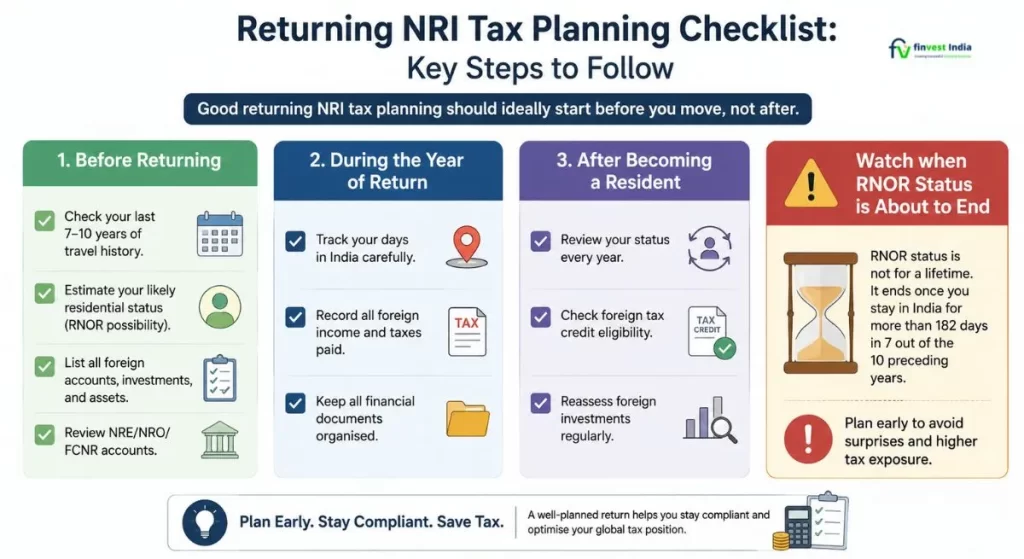
Good returning NRI tax planning should ideally start before you move, not after.
Before returning
- Check your last 7-10 years of travel history.
- Estimate your likely residential status (RNOR possibility).
- List all foreign accounts, investments, and assets.
- Review NRE/NRO/FCNR accounts.
During the year of return
- Track your days in India carefully.
- Record all foreign income and taxes paid.
- Keep all financial documents organised.
After becoming a resident
- Review your status every year.
- Check foreign tax credit eligibility.
- Reassess foreign investments regularly.
- Watch when RNOR status is about to end
Common Returning NRI Taxation Mistakes to Avoid
For resident taxation in India, the real shift is not just paying tax in India, it is understanding when your global income, assets, and foreign taxes all start coming into the Indian tax system.
- The most common mistake is assuming that returning to India automatically makes you ROR. It doesn’t.
- Another mistake is thinking RNOR means “no tax at all”. That’s not true either.
- Many people also mix up FEMA rules with income tax rules, which leads to incorrect assumptions about bank accounts and reporting.
- Foreign asset reporting is another blind spot. People report income but forget about disclosure requirements.
- And finally, many continue using their old NRI tax approach even after becoming residents. That can create problems once worldwide income becomes taxable.
Returning NRI Taxation: Getting Your Finances Back on Track With Finvest India
Coming back to India often feels like closing a big chapter of your life, but financially, things don’t wrap up that neatly. Your tax situation, especially, needs a fresh look once your residential status changes. Returning NRI taxation depends on a few key things, and it is worth sorting this out early so you don’t run into avoidable issues later.
Many NRIs find that their goals shift after returning, and their portfolio needs a bit of realignment too. This is where NRI Investment Services in Bangalore can help you decide what to do next and how to adjust your finances after moving back. They can also help you with your existing investments, including whether GIFT City/IFSC options make sense for you, and how to realign your portfolio to fit your current life in India.
Disclaimer: Tax rules and reporting requirements can change, and your situation may differ from the examples below. Please verify the rules applicable to your case, ideally with a qualified tax professional, before making filing or investment decisions.