

Real Estate vs Mutual Funds for NRIs: Returns, Tax, Risk & Liquidity
Imagine you’ve saved ₹50 lakh while working abroad and now you’re thinking of putting it to work in India. Your family immediately says, “Buy a flat. Property is always a good investment.” On the other hand, your financial expert leans towards mutual funds because they’re easier to manage and far more liquid.
And just like that, you’re stuck with a very real question: real estate vs mutual funds, which one actually makes sense for you?
The truth is, both can help you build wealth, but they work in completely different ways. Property can give you rental income and long-term appreciation, but it also comes with maintenance, paperwork, and the challenge of managing something physical from another country. Mutual funds, on the other hand, give you diversification and flexibility without the hassle of direct ownership.
Then there are the practical complications, taxes, FEMA rules, repatriation limits, risk levels, and how quickly you might need access to your money if plans change.
So instead of going by what people “generally say,” it makes more sense to actually compare both properly, across returns, tax impact, liquidity, risks, and your specific NRI goals. And in some cases, the answer may not be choosing one over the other, but understanding when a mix of both actually works better.
“We see this pattern constantly with NRIs,” says Prashanth Jogimutt, Founder of Finvest India. The real question usually isn’t property versus mutual funds; it’s when you’ll actually need the money back. An NRI planning to move back to India in three years has a completely different allocation problem than one who’s settled abroad for good. Once you’re clear on your own timeline, the rest of the decision gets a lot easier.
- Choose property if you have a genuine reason to own a home in India, a long-term horizon, and someone you trust to manage it locally.
- Choose mutual funds if you value liquidity, want to diversify easily, or aren’t sure yet when you’ll need the money.
- Consider both if you have enough capital to treat property as a use-case decision and mutual funds as your growth engine, which, for most NRIs, is exactly where this lands.
Table of Contents
Real Estate vs Mutual Funds for NRIs: Quick Comparison
For an NRI, real estate vs mutual funds is not just about returns. It’s really a mix of taxation, liquidity, risk, effort, FEMA rules, and how easily you can move money back abroad.
Factor | Indian Real Estate | Mutual Funds |
Returns | Capital appreciation + rental income | Market-linked growth |
Entry costs | Stamp duty, registration, brokerage | Low; no entry load |
Ongoing costs | Maintenance, property tax, vacancy | Expense ratio (now split into Base Expense Ratio + statutory levies from FY26) |
Time to exit | Weeks to months, sometimes longer | Days |
Tax on gains | Section 112, 12.5% LTCG, no indexation | Depends on fund type and holding period |
TDS | On the entire sale value, under Section 195 | On income/distributions, under Section 196A |
Currency exposure | Yes, INR asset, foreign-currency investor | Yes, same exposure, but easier to rebalance |
Remote management | Needs a trusted person on the ground | None needed |
Diversification | One asset, one location | Spread across many holdings |
Regulatory home | RBI / FEMA |
Comparing Returns: Real Estate vs Mutual Funds
How Do NRIs Earn Returns From Indian Real Estate?
An NRI typically earns from property in two ways: capital appreciation and rental income.
Capital appreciation is simply when the property value goes up over time. Rental income is the monthly or yearly cash flow if the property is leased out.
But here’s the part people often miss: the purchase price is not your real cost or your real return.
You also have:
- Stamp duty and registration.
- Brokerage.
- Maintenance and repairs.
- Property tax.
- Vacancy periods (no tenant = no rent).
Location also plays a huge role. A property in a strong job market or growing infrastructure zone behaves very differently from one in a slow or stagnant area.
That is why NRI real estate investment should never be judged just by “property prices went up.”
How Do NRIs Earn Returns From Mutual Funds?
An NRI mutual fund investment works differently. Here, returns come from the growth of the underlying investments.
- Equity funds invest in stocks.
- Debt funds are products that invest in fixed income.
- Hybrid funds are a blend of the two.
You can invest either as a lump sum or through SIP, depending on your comfort level.
The benefit of SIPs is that you don’t put in all your money at once but spread it across time.
In this case, the time horizon is quite important. Equity funds can move up and down strongly in the near term, but over longer periods they tend to flatten out.
Also, The SEBI (Mutual Funds) Regulations, 2026 were notified on 14 January 2026 and came into force on 1 April 2026, replacing the 1996 framework. For investors, the practical change is that instead of a single packaged Total Expense Ratio, you now have a separate Base Expense Ratio, which means what you really pay an AMC to manage your money is now stated separately, away from brokerage, STT and other statutory fees.
Which Can Deliver Better Returns?
A well-chosen property can beat a bad mutual fund. A well-managed mutual fund portfolio can also outperform a poorly chosen property. So, comparing returns should always include:
- Time period
- Costs
- Taxes
- Risk
Tax Implications for NRIs: Real Estate vs Mutual Funds
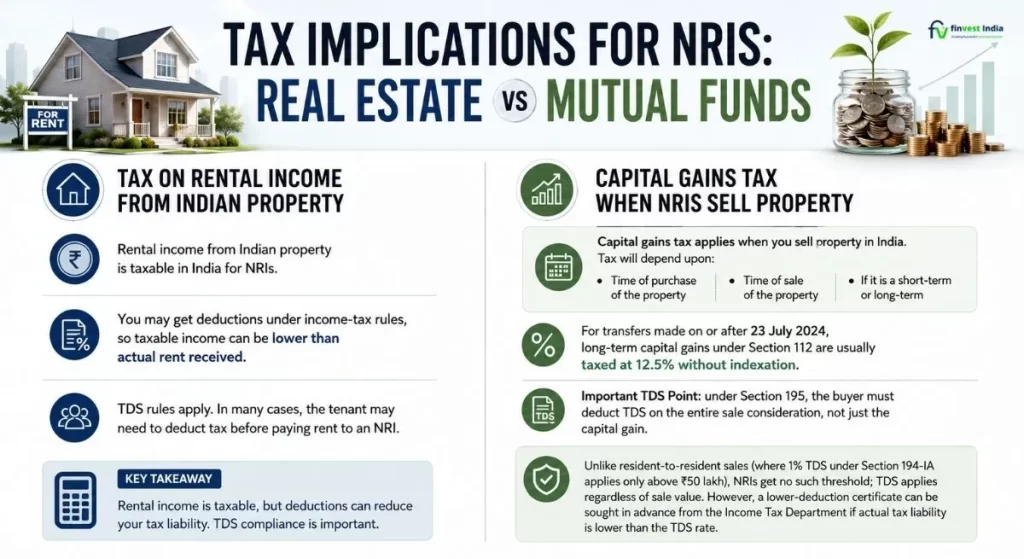
Tax on Rental Income From Indian Property
Rental income from Indian property is taxable in India for NRIs.
But it’s not as simple as “full rent is taxed.” You may get deductions under income-tax rules, so taxable income can be lower than actual rent received. Also, TDS rules apply. In many cases, the tenant may need to deduct tax before paying rent to an NRI.
Capital Gains Tax When NRIs Sell Property
When you sell property in India, capital gains tax usually applies. Tax will depend upon:
- Time of purchase of the property.
- Time of sale of the property.
- If it is a short-term or long-term.
In case of transfers made on or after 23 July 2024, long-term capital gains under Section 112 are usually taxed at 12.5 percent without indexation.
Another important point is TDS: under Section 195, the buyer must deduct TDS on the entire sale consideration, not just the capital gain, a key difference from resident-to-resident property sales, where the 1% TDS under Section 194-IA applies only above a ₹50 lakh threshold. NRIs get no such threshold; TDS applies regardless of sale value, though a lower-deduction certificate can be sought in advance from the Income Tax Department if the actual tax liability is lower than the TDS rate.
Taxation on Mutual Fund Investments for NRIs
This is where precision is needed because the two rules are often confused. Once you provide a Tax Residency Certificate, the fund house withholds 20% (plus surcharge and cess) or the DTAA rate if lower on mutual fund income distributions to non-residents under Section 196A. Capital gains on redemption are taxed separately per fund category (equity, debt, or hybrid) and duration of holding, so don’t think one flat rate covers all mutual fund investment taxes.
TDS Rules NRIs Should Know
TDS can affect your cash flow even if your final tax is different. Per AMFI’s official guidance on the tax regime for mutual funds, TDS is deducted at source regardless of your eventual tax liability, and if a Tax Residency Certificate isn’t furnished, the rate defaults to a higher. So don’t confuse:
- TDS deducted at source, with
- Final tax liability
Repatriation and Tax Considerations
- Purchased from Foreign Currency Funds (NRE/FCNR Account)? Under some conditions, it would be able to remit a sum similar to the original investment amount. However, in other situations, it is limited to two residential properties by the RBI’s FEMA guidelines.
- Did you purchase using rupee funds (NRO account)? Repatriation is covered under NRO limit of USD 1 million per financial year, coupled with Forms 15CA and 15CB.
- In any case, your nation of residence might also tax this income or wish to know about it; a DTAA can prevent you from being taxed twice on the same money.
Liquidity Comparison: Real Estate vs Mutual Funds
How Quickly Can an NRI Sell Indian Property?
Property is not liquid. To sell it you need:
- A purchaser
- Price negotiations.
- Legal checks
- Registration process
- TDS compliance
- Banking formalities
And if you’re overseas, it’s even more complicated. Many NRIs rely on a power of attorney or a family member to handle things locally.
How Easily Can an NRI Redeem Mutual Funds?
Mutual funds are much simpler. You can place a redemption request through the AMC or platform, and the money is processed based on scheme rules.
Some funds may have:
- Exit loads
- Settlement delays
But overall, it is still far easier than selling property. For NRIs, proceeds are credited based on banking setup and repatriation rules.
Which Is Better for Liquidity?
In most cases, liquidity comparison clearly favours mutual funds.
That said, mutual funds are not “instant cash machines” either. Market conditions and fund rules still apply.
Risk Factors: Real Estate vs Mutual Funds
Risks of Investing in Indian Real Estate
Risk factors in property include:
- Location risk
- Title/legal issues
- Builder quality
- Tenant problems
- Vacancy periods
- Maintenance costs
There is also concentration risk. If you invest ₹1 crore in one property, your entire return depends on one asset in one location.
Risks of Investing in Mutual Funds
Mutual funds also carry risk.
- Equity Funds = Market Volatility
- Debt Funds = Interest Rate Risk + Credit Risk
- Fund = Underperformance Risk
Additional for NRIs = Currency Risk. If the INR weakens against the USD, your returns may be reduced when converted back.
Which Is Riskier?
It depends. Property is not automatically “safe” just because prices don’t move daily. A bad property can lock your money for years.
Similarly, mutual funds are not all high-risk. A debt fund behaves very differently from an equity fund. So the real comparison is about:
- Diversification
- Time horizon
- Risk tolerance
- Ability to handle volatility
The Finvest India NRI Allocation Framework
Here’s a simple diagnostic you can run on your own situation before you talk to anyone. Score yourself 1 (low) to 3 (high) on each factor:
Factor | What it’s asking |
Liquidity need | How likely are you to need this money back within 3–5 years? |
Involvement capacity | Can you realistically manage tenants, repairs, and paperwork from abroad, yourself or through someone you trust? |
Currency sensitivity | Does your income and spending happen mostly in foreign currency, making INR-denominated illiquid assets riskier for you specifically? |
Return-to-India intent | Is there a real, non-financial reason to own property (a home for parents, a future base)? |
How to read your score:
- High liquidity need + low involvement capacity → Lean toward mutual funds for the bulk of new investment; treat property only as a use-case decision (a home, not a “return”), not a portfolio decision.
- Low liquidity need + genuine return-to-India intent → Property can carry a larger share, provided it’s one well-chosen asset, not a concentration bet dressed up as diversification.
- High currency sensitivity → Weight mutual funds higher regardless of the other three factors, since a weakening rupee compounds against an already illiquid asset.
- Mixed scores → This is the most common outcome, and it’s the honest argument for a hybrid allocation rather than an all-or-nothing choice.
This approach won’t replace a conversation with an expert who knows your whole financial situation, but it transforms “real estate vs. mutual funds” into four questions you can answer about yourself.
Which Investment Option Suits Different NRI Goals?
For Long-Term Wealth Creation
If you can handle market ups and downs, diversified equity mutual funds are often considered for long-term growth. But property can also build wealth if:
- Location is strong.
- Entry price is reasonable.
- The holding period is long.
For Regular Income
Property can give rental income, but it is not always stable.
Mutual funds also don’t guarantee fixed income unless you structure withdrawals.
So neither of them should be treated as guaranteed income.
For Liquidity
If you want easy access to money, mutual funds are usually better.
Property is better when you don’t need frequent access to funds.
For Owning a Physical Asset in India
A property investment for an NRI makes sense when there is a real purpose:
- Future return to India
- Home for parents
- Personal use planning
For Diversification
Mutual funds make diversification simple.
One fund can give exposure to many companies.
A single property is always concentrated. You can buy multiple properties, but that needs much higher capital and effort.
For Passive Investing
Mutual funds are far more passive.
Property needs ongoing attention:
- Repairs
- Tenants
- Society issues
- Documentation
For NRIs living abroad, this can become a real challenge.
For Investors With Limited Capital
Property usually needs a large upfront amount.
Mutual funds allow you to start small and build gradually.
That’s why they are often more accessible for NRIs starting out.
Can NRIs Invest in Both Real Estate and Mutual Funds?
Yes, and that’s actually the smarter approach. A hybrid investment strategy allows you to split goals:
- Property for long-term physical asset needs.
- Mutual funds for liquidity and growth.
Example:
- A Non-Resident Indian can be interested in purchasing a house in India.
- Another may focus on market investments for wealth creation.
- A balanced investor may do both.
The right mix is built on:
- Income
- Age
- Tolerance for risk
- Foreign exchange risk
- Future steps
- Tax residence
NRI Rules for Investment in Indian Real Estate
Can NRIs Buy Property In India?
Yes. FEMA guidelines generally allow NRIs and OCIs to buy residential and commercial property in India. Agricultural land, farm homes and plantation property are curtailed. Payments must be made through proper banking channels such as:
- NRE account
- FCNR(B) account
- NRO account
Property type | NRI/OCI position |
Residential | Generally permitted |
Commercial | Generally permitted |
Agricultural land | Generally restricted |
Farmhouse | Generally restricted |
Plantation property | Generally restricted |
What Happens When an NRI Sells Property?
While selling your property, you can encounter:
- Capital Gains Tax
- TDS Deductions
- Requirements of documents
If the property was acquired through the use of eligible foreign currency or an NRE/FCNR account, remittance will be possible only in accordance with specific conditions (the limit is set to two properties in some cases).
If the remittance was purchased with rupee funds, it may be subject to the USD 1 million per financial year restriction; limitations may apply.
Can NRIs Invest in Indian Mutual Funds?
NRI Eligibility and Restrictions
NRIs are allowed to invest in mutual funds in India. But
- Not all AMCs accept all countries.
- Some may be subject to residence restrictions.
NRE vs NRO Accounts
- NRE account → foreign income, repatriable
- NRO account → Indian income, limited repatriation
KYC and Documentation Requirements
The important documents which are required:
- PAN
- Passport
- Overseas address proof
- Bank details
- FATCA/CRS declarations
SIP vs Lump-Sum Investing for NRIs
- SIP → gradual investing, reduces timing risk.
- Lump sum → suitable when you already have capital ready.
Both are valid. It depends on your cash flow and comfort.
Are All Mutual Funds Available to NRIs?
No. Availability depends on:
- AMC policy
- Country of residence
- Regulatory restrictions
So always check before starting a mutual fund investment in India.
Four NRIs, Four Different Answers
- Dubai-based, 3-year horizon: Wants the money back for a possible move. Mutual funds fit better; liquidity matters more than a physical asset right now.
- US-based, planning to return in 10 years: Has a real reason to own a home. Property makes sense here, as one carefully chosen asset, not a portfolio decision.
- Settled abroad permanently, ₹1 crore to invest: No return-to-India plan. A single property becomes a concentration risk with no real upside over a diversified fund portfolio.
- Wants both: The most common answer. Property for the emotional and use-case need, mutual funds for the growth and liquidity need, sized differently, not chosen exclusively.
Real Estate vs Mutual Funds: What NRIs Should Know About Choosing the Right Investment?
When NRIs think about real estate vs mutual funds, the honest answer is it depends on your own situation, your financial objectives, how much risk you can take, your tax status, and whether you intend to return to India or settle overseas permanently.
Want to apply this framework to your own numbers? Run the four scores above, then be honest about where you land. If you’d rather talk it through, Finvest India’s financial assessment service is built to work through your liquidity needs, return-to-India plans, currency exposure, and existing investments with you, before you decide how much, if any, goes into property.
Disclaimer: This article is for general information only and isn’t personalised financial, tax, or legal advice.