

I received a call a few months ago from my cousin in Canada. He had some decent savings and wants to start NRI Investing in India. He was excited. The Indian market was doing well, mutual funds looked promising, and he was even thinking about buying a small apartment in Kochi for his parents.
But within an hour, his excitement turned into confusion.
One website said he needed an NRE account. Another talked about NRO accounts. Then there were FEMA rules, tax rules, repatriation limits, and terms he had never heard before. His simple question was, “Why is investing my own money so complicated?” And honestly, that is where many NRIs struggle.
India offers plenty of opportunities to grow your money. But if you don’t understand the rules first, even a small mistake can create problems later. The good news is you don’t need to be a finance guru to make sense of it all. In this blog, we will take you through important laws and regulations, investment opportunities, taxes, and account types to know before you invest in India.
Table of Contents
Why More NRIs Are Investing in India?
India’s economy is still one of the fastest-growing in the world. As per RBI data provided by Business Standard, NRI deposits with Indian banks were at about USD 168 billion mid-2025, up from about USD 156 billion a year ago. In the case of stocks, NRI holdings in the Indian stock market were estimated about ₹5.2 lakh crore as of March 2026, still barely over 1% of India’s overall market value of roughly ₹461 lakh crore, which is precisely why authorities have been opening the door wider for overseas capital.
Over the years the stock market has generated wealth, mutual funds are becoming popular and buyers are being attracted to real estate and infrastructure. Many NRIs are choosing to invest in India since it allows them to diversify their portfolio along with the profits. You can spread your investments across countries and currencies to diversify and add stability to your finances.
Expert Insight: Most of the NRIs I work with don’t really need more investment options; they need clarification on which account to go through, which path to take, which compliance step comes first. The 2026 adjustments have expanded the menu, but the order of operations still matters more than the menu.
Who Qualifies as an NRI for Investment Purposes?
Before investing, the first thing you need to understand is your residential status.
Definition of NRI Under FEMA
As per FEMA regulations, a non-resident Indian is an Indian citizen who resides outside India for employment, business or any other purpose that indicates an uncertain period of stay outside India.
This is important since FEMA controls the manner in which NRIs can invest, move money and withdraw money from India.
Difference Between NRI, OCI, and PIO
An NRI is an Indian citizen residing outside India.
An Overseas Citizen of India (OCI) is a foreign citizen of Indian heritage who has certain investment rights in India.
Earlier, PIO ( Person of Indian Origin ) was a separate category but presently it has been combined with OCI.
Understanding NRE, NRO, and FCNR Account Usage Before Investing
One of the first stages for NRI Investing in India is to open the correct bank account.
1. NRE Account Features and Benefits
An NRE account is meant for income received outside of India. The main advantage of this account is that both the principal and the interest are fully repatriable. This means you can send money internationally without any limits. In addition, the interest earned is normally tax free in India.
2. NRO Account Features and Benefits
Income earned in India is handled through an NRO account. For example:
- Rental income.
- Pension.
- Dividends.
- Property sale proceeds.
- Other Indian earnings.
Unlike an NRE account, repatriation from an NRO account is subject to various limits and RBI rules.
3. FCNR Account Features and Benefits
FCNR Account : It is an account for NRIs to maintain deposits in foreign currencies. This helps protect your money from exchange rate swings and gives you full repatriation benefits.
4. NRE vs NRO Account: Which One Should You Use for Investing in India?
If you wish to spend your foreign earnings and also make payments to your home country then generally NRE accounts are the better option.
You must have an NRO account to transfer money from India. More NRIs are using both accounts depending on where their money is coming from and their financial goals.
Choosing the right account is easier with NRI Investment Services in Bangalore, ensuring your investments comply with RBI and FEMA regulations.
Key Regulatory Framework Governing NRI Investing in India
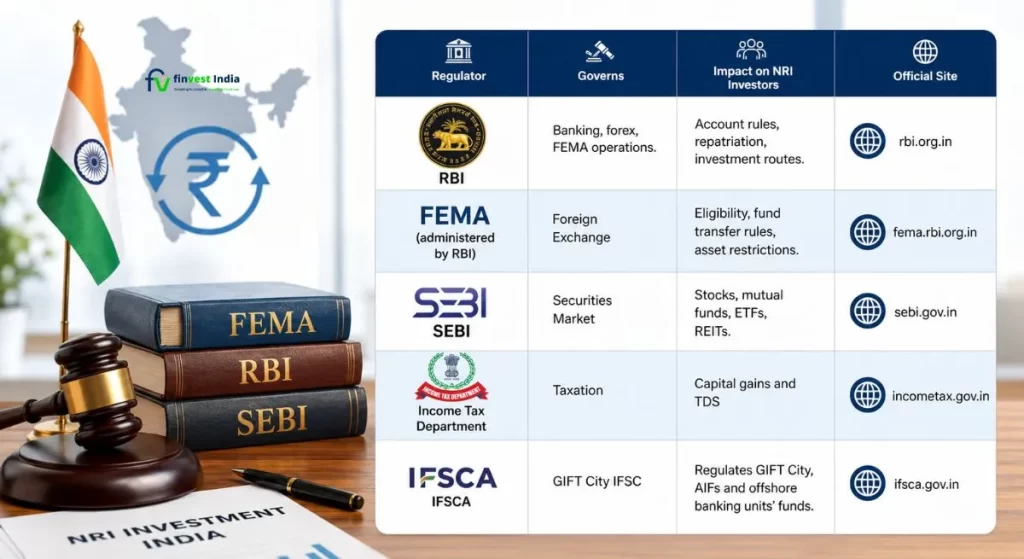
There are few authorities that control NRI investments in India. Knowing what they do can make investing a lot easier.
Role of RBI in NRI Investments
The Reserve Bank of India handles the foreign exchange and the Indian banks. It provides:
- Rules for NRE, NRO, and FCNR accounts.
- Repatriation guidelines.
- Investment routes available to NRIs.
- Foreign exchange regulations.
FEMA Regulations Every NRI Must Understand
FEMA is one of the most essential law governing NRI investments. It says:
- Which investments can NRIs make?
- How funds can be transferred.
- Repatriation rules.
- Restrictions on certain assets.
For example, NRIs are often not allowed to own agricultural land, plantation property or farmhouses in India.
SEBI Guidelines for Market Investments
The Securities and Exchange Board of India is the regulator of securities market in India. If you are investing in stocks, mutual funds, ETFs or REITs, SEBI’s rules directly affect you.
Income Tax Rules Affecting NRI Investors
Income Tax Department taxes NRIs on capital gains, dividend, interest income and property transactions. If you know the tax implications going in, you can plan exits and repatriation much more effectively.
| Regulator | Governs | Impact on NRI Investors | Official Website |
|---|---|---|---|
| Reserve Bank of India (RBI) | Banking, foreign exchange, and FEMA operations | Regulates NRE/NRO/FCNR accounts, repatriation of funds, and permissible investment routes for NRIs. | https://www.rbi.org.in |
| Foreign Exchange Management Act (FEMA) (Administered by RBI) | Foreign exchange regulations | Defines NRI eligibility, cross-border fund transfer rules, property ownership, and investment restrictions in India. | https://www.fema.rbi.org.in |
| Securities and Exchange Board of India (SEBI) | Securities and capital markets | Regulates investments in stocks, mutual funds, ETFs, bonds, REITs, and portfolio management services for NRIs. | https://www.sebi.gov.in |
| Income Tax Department | Taxation | Governs capital gains tax, Tax Deducted at Source (TDS), tax filing, and other tax obligations for NRI investments. | https://www.incometax.gov.in |
| International Financial Services Centres Authority (IFSCA) | GIFT City IFSC | Regulates financial institutions, Alternative Investment Funds (AIFs), offshore banking units, and investment products operating within GIFT City IFSC. | https://www.ifsca.gov.in |
Latest RBI Updates Shaping NRI Investing in India in 2026
RBI has made several changes to make it easier for NRIs to invest.
- Individual investment limit in Indian publicly traded companies raised to 10% from 5%.
- Likewise, NRIs and OCIs will now be subject to aggregate investment cap of 24%.
- Another milestone has been the creation of special repatriable rupee accounts which allow international investors to repatriate the proceeds of their investment abroad after paying their taxes.
What hasn’t changed: Agricultural land, plantation property and farmhouses remain out of bounds under FEMA, intraday trading is still not permitted for NRIs (delivery-based only) and RBI continues to monitor foreign-ownership ceilings on a daily basis with internal cut-off alerts two percentage points below the formal limit.
Expert Insight: The leap from 10% aggregate ceiling to 24% matters more than people understand. Previously popular mid-cap and small-cap stocks would often reach the old NRI ownership ceiling and banks would just prohibit further NRI purchases in those names. Now with additional room, NRIs can access a considerably bigger universe of investable stocks, but the 10% individual cap per company is a hard FEMA limit and violating it, even mistakenly across several brokers, is a compliance violation irrespective of purpose.
NRI Investing in India: A Compliance Checklist for 2026
| Step | What to Verify |
|---|---|
| Account Setup | Ensure your NRE, NRO, or FCNR account is opened with an RBI-authorized bank and your KYC details have been updated within the last 12 months, if required. |
| Equity Exposure | Verify that your individual holding in any single listed company does not exceed 10% of its paid-up equity capital, as applicable under current regulations. |
| Aggregate Exposure | Confirm that the combined NRI/OCI shareholding in the company remains within the applicable sectoral investment cap (commonly 24%, unless increased by the company through shareholder approval). |
| Trading Mode | Ensure all equity transactions are delivery-based and that intraday trading is avoided, where applicable under your investment route. |
| Repatriation | Track outward remittances from your NRO account to ensure they remain within the USD 1 million cumulative limit per financial year, subject to RBI regulations and documentation requirements. |
| Documentation | Keep Form 15CA and Form 15CB (or the applicable replacement forms if regulatory changes take effect) ready for eligible NRO remittances exceeding the prescribed threshold. |
| Tax Filing | Claim Double Taxation Avoidance Agreement (DTAA) benefits by submitting a Tax Residency Certificate (TRC) and Form 10F, wherever applicable. |
| Restricted Assets | Verify that you have not purchased agricultural land, plantation property, or farmhouses, except where specifically permitted under Indian law. |
| Cross-border Reporting | Ensure your FATCA and CRS declarations are up to date with your bank, mutual fund house, or stockbroker to maintain regulatory compliance. |
Top Investment Options to Consider for NRI Investing in India
Today, you can find many NRI investment options in India.
1. Equity Investments Through PIS and Non-PIS Routes
NRIs can invest in the shares of listed Indian companies through the approved methods of investment. Equity investing are still one of the most preferred ways to create wealth in the long run.
2. Mutual Funds for NRIs
NRIs can invest in:
- Equity mutual funds.
- Debt mutual funds.
- Hybrid funds.
- SIP for NRIs.
- Lump sum investments.
3. Fixed Deposits and Bonds
Conservative investors who are looking for steady returns still prefer NRE, NRO and FCNR fixed deposits.
4. Government Securities and RBI Bonds
Investment in government-backed securities is a somewhat safer option with less risk.
5. Real Estate Investments
NRIs can invest in:
- Residential properties.
- Commercial properties.
But agricultural land and plantation properties remain prohibited under FEMA.
6. Alternative Investments and REITs
Non-resident Indians (NRIs) can invest in real estate through REITs instead of buying a real property.
Indian Stock Market Regulations Every NRI Investing in India Should Know
Stock market investments come with specific rules for NRIs.
1. Portfolio Investment Scheme (PIS) Rules
The Portfolio Investment Scheme permits NRIs to purchase and sell shares of Indian companies on the recognized stock exchanges.
2. Demat and Trading Account Requirements
To invest in stocks, you’ll need:
- A demat account that will be used to hold shares in electronic form.
- A trading account is used to buy and sell stocks.
3. Sectoral Investment Limits
India has limits on foreign investment in some sectors. It’s always important looking at what constraints are in place for the company/sector before investing.
4. Repatriation Rules for Equity Investments
Investments made through NRE accounts are generally repatriable to the investor. Investments made from NRO accounts may be subject to repatriation and documentation restrictions.
5. A Step-by-Step Guide to Opening a PIS Account for NRI Stock Investments
- Open an NRE or NRO account with an RBI authorised bank.
- Apply for PIS approval at the same or connected bank.
- Full KYC (PAN, Passport and international address evidence).
- Open and link a trading and demat account with a registered broker.
- Start investing in Indian shares, keeping in mind the per company individual (10%) and aggregate (24%) limits.
Mutual Fund Regulations for NRI Investors
Investing in mutual funds is easy, but there are few significant conditions.
- Must complete KYC before investing.
- NRIs should also follow the rules laid out by FATCA and CRS.
- If you live in the United States, Canada or other countries, some mutual fund companies may have limits on you as an investor because of additional reporting requirements.
Taxation Rules Every NRI Investor Should Understand
A major factor of NRI Investing in India is taxation. Knowing them in advance helps you prevent surprises later on.
1.Tax on Equity Investments
Shares sold are liable for capital gains tax. Tax rate varies on:
- Holding period.
- Type of gain.
- Relevant tax law.
2. Tax on Mutual Funds
The tax treatment of mutual funds is different for equity and debt funds. It is also affected by the holding term.
3. Tax on Fixed Deposits and Bonds
Interest earned on certain deposits and bonds may be taxable in India.
4. Taxation and TDS Provisions
Tax Deducted at Source (TDS) may apply to:
- Dividends.
- Interest income.
- Property transactions.
- Certain capital gains.
5. Double Taxation Avoidance Agreements (DTAA)
India has DTAA agreements with quite a few countries. These kinds of treaties prevent double taxation on the same income by two different countries i.e. India and the country where they reside.
Important Repatriation Rules That Affect NRI Investing in India
Repatriation is the transfer of money from India to your country of residence. This is one area that every NRI should know before making an investment.
Repatriable vs Non-Repatriable Investments
With repatriable investments, you can send both the capital and the returns to a different country. Most of the purchases in this group are made through NRE accounts.
Most of the time, non-repatriable investments are linked to NRO accounts and may limit the movement of capital to other countries.
Common Compliance Mistakes NRIs Make While Investing
Even seasoned investors often miss key compliance needs. Common mistakes are:
- Investing from the wrong account.
- Forget FEMA regulations.
- KYC docs that are not being updated.
- No FATCA compliance.
- Ignoring tax obligations.
- Not preparing the repatriation process correctly.
Expert Insight: The biggest mistake we see is not a bad investment decision, but sequencing. NRIs first choose the fund or stock, then find the account and compliance trail. Reverse that order: confirm the repatriation path, get the right account and then pick the investment. This will save you weeks of back and forth later with the bank.
Make Smarter Decisions With NRI Investing in India
NRI Investing in India is not only about selecting the best investment option. The first thing is to know the rules and invest with clarity. Once you understand how FEMA rules, taxes, repatriation limits and bank accounts work, it is much easier to make selections. You don’t need to do everything yourself either. NRIs can take help from reliable financial platforms like Finvest India to keep themselves updated and obtain a better understanding of the Indian investing situation. So it’s easy to plan investments with certainty and a long-term view.
Disclaimer: This article is for general informational purposes and does not constitute investment, tax, or legal advice.