

After Retirement Investment Plans: How to Choose the Best Options Based on Your Risk Profile (2026 Guide)
Rajesh retired at 60 with what looked like enough savings. For a few months, things felt fine. Then expenses stayed the same, medical bills showed up, and income stopped. His money was sitting in safe places, but it wasn’t growing enough. Slowly, pressure started building.
The pressure Rajesh felt is common. The real challenge is not just saving, it’s choosing the right after retirement investment plans.
In this blog, we’ll break down how to choose them based on your risk profile, so your money supports you the way it should.
Table of Contents
Why is Investment Planning Important After Retirement?
After retirement, money works differently. There’s no fixed income, so savings and returns are relied on to manage daily needs. This is where professional Retirement Planning Services in Bangalore can help create a stable retirement income strategy.
A few key risks come into play:
- The Longevity Risk: Indians are living longer. Your money may now need to last 25–30 years.
- The Healthcare Shock: According to the Medical Inflation Trends 2026 Report, healthcare costs in India are rising at 14% annually. A procedure costing ₹1,00,000 today could cost nearly ₹2,00,000 by 2031.
- Tax Erosion: Without a strategy, a large chunk of your interest income could be lost to taxes, reducing your actual “in-hand” cash.
Understanding Risk Profiles Before Choosing After Retirement Investment Plans
What is a Risk Profile?
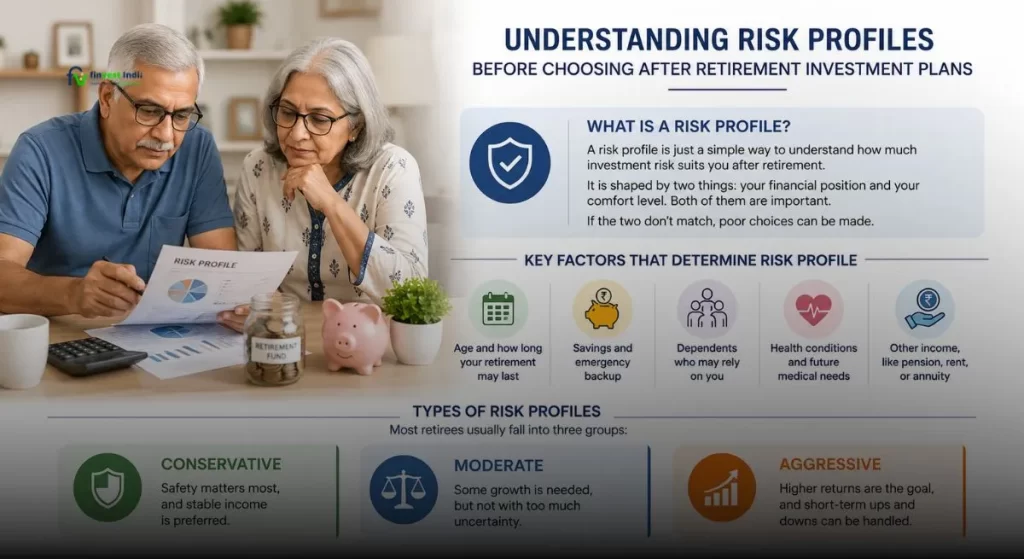
A risk profile is just a simple way to understand how much investment risk suits you after retirement. It is shaped by two things: your financial position and your comfort level. Both of them are important. If the two don’t match, poor choices can be made.
Risk tolerance alone is not enough. Income patterns and financial stability also matter, especially when learning How to Choose the Right Self-Employed Retirement Plans Based on Your Income.
Key Factors That Determine Risk Profile
A few things usually decide your risk profile:
- Age and how long your retirement may last.
- Savings and emergency backup.
- Dependents who may rely on you.
- Health conditions and future medical needs.
- Other income, like pension, rent, or annuity.
Types of Risk Profiles
Most retirees usually fall into three groups:
- Conservative: safety matters most, and stable income is preferred.
- Moderate: some growth is needed, but not with too much uncertainty.
- Aggressive: higher returns are the goal, and short-term ups and downs can be handled.
What Are the Best After-Retirement Investment Plans in India?
You can choose how much risk you’re okay with. Still, some post-retirement investment options are used more often because they fit different comfort levels.
- Low Risk: Fixed Deposits, Senior Citizens Savings Scheme (SCSS), Government Bonds
- Moderate Risk: Hybrid Mutual Funds, Annuity Plans
- High Risk: Equity Mutual Funds, Stocks, REITs
A balanced mix of these investments helps generate stable income, liquidity, and long-term growth after retirement.
Conservative (Low Risk)
You’ll naturally lean towards things that don’t surprise you:
- Fixed deposits
- Senior Citizens Savings Scheme
- Post Office Monthly Income Scheme
- Government bonds
These are steady. You know what you’ll get. The trade-off is simple: returns don’t always keep up with inflation.
Moderate (Balanced Risk)
This is where most people land.
- SEBI-regulated “Life Cycle Allocation” funds and hybrid mutual funds
- Annuity plans
- Dividend-paying stocks
Here, the idea is simple: don’t go all-in on safety, but don’t take big risks either.
Aggressive (Higher Risk)
Then a small part can go into growth:
- Equity mutual funds
- Stocks and REITs
- Selected ULIPs
Returns can be better, but it won’t be smooth. That part needs attention.
In the end, the best investment plans after retirement in India aren’t about picking one option. It’s about putting together a mix that you can stick with.
Since equity mutual funds need the right selection and timing, getting guidance from a mutual fund distributor can help avoid common mistakes.
Expert Insight: In 2026, retirement planning is no longer about avoiding risk completely. It is about managing inflation and longer life expectancy. A mix of safe income and growth assets is necessary because retirement can easily last 25-30 years.
Senior Citizen Savings Scheme (SCSS) vs PMVVY Comparison
| Feature | Senior Citizen Savings Scheme (SCSS) | Pradhan Mantri Vaya Vandana Yojana (PMVVY) |
|---|---|---|
| Purpose | Regular income with capital safety | Assured pension for existing subscribers |
| Eligibility | Senior citizens meeting the scheme’s eligibility conditions | Existing policyholders (closed for new subscriptions) |
| Risk Level | Very Low | Very Low |
| Returns | Government-notified and revised periodically | Fixed as per the policy issued at the time of purchase |
| Payout Options | Quarterly interest payments | Monthly, quarterly, half-yearly, or annual pension options (as per policy) |
| Premature Exit | Permitted under prescribed conditions with applicable penalties | Limited surrender provisions under policy terms |
| Tax Treatment | Interest is taxable as per applicable income tax rules | Pension received is taxable under applicable income tax provisions |
| Best For | Retirees seeking secure and regular income | Existing investors holding PMVVY policies |
Examples Of Post-Retirement Income Strategies Based on Risk Profile
| Risk Profile | Example Scenario | Suggested Asset Allocation | Objective |
|---|---|---|---|
| Conservative | Mr. Sharma (Age 65) has ₹60 lakh, receives no pension, and wants predictable monthly income with minimal risk. | 50% Senior Citizen Savings Scheme (SCSS)25% Bank Fixed Deposits15% Post Office Monthly Income Scheme (POMIS)10% Liquid Mutual Funds | Generate stable income while preserving capital and maintaining emergency liquidity. |
| Moderate | Mrs. Rao (Age 62) has ₹1 crore, receives a small pension, and wants income today with protection against inflation. | 35% SCSS25% Hybrid Mutual Funds20% Debt Mutual Funds10% Annuity Plan10% Liquid Funds | Balance regular income, moderate growth, and liquidity for future needs. |
| Growth-Oriented | Mr. and Mrs. Mehta (Age 61) have ₹2 crore, own their home, and have rental income. They can tolerate short-term market volatility. | 30% Equity Mutual Funds20% Hybrid Funds20% SCSS15% REITs or Dividend-Oriented Investments15% Liquid/Debt Funds | Create long-term wealth, manage inflation, and maintain diversified retirement income. |
Asset Allocation Strategies for Retirees for After Retirement Investment Plans
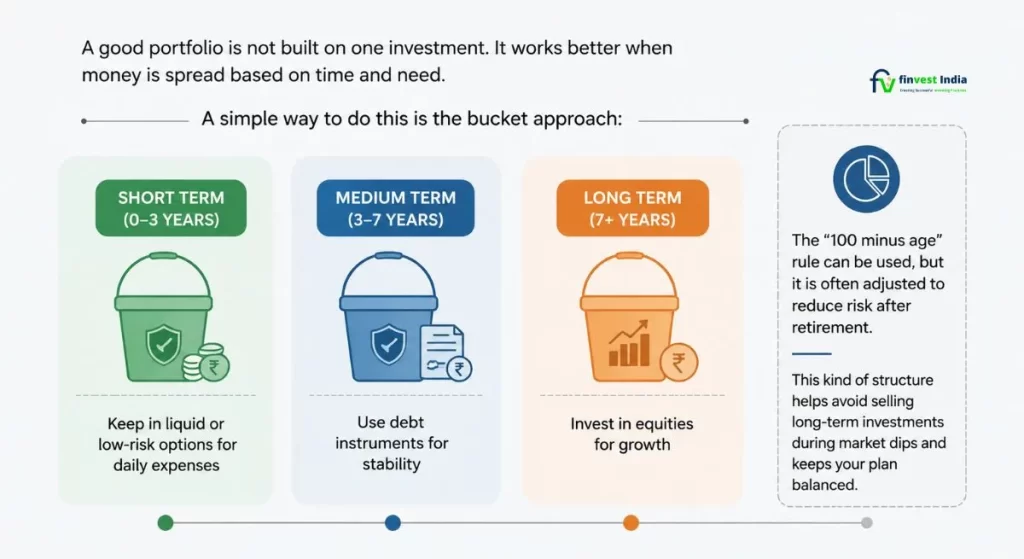
A good portfolio is not built on one investment. It works better when money is spread based on time and need.
A simple way to do this is the bucket approach:
- Short term (0-3 years): keep in liquid or low-risk options for daily expenses
- Medium term (3-7 years): use debt instruments for stability
- Long term (7+ years): invest in equities for growth
The “100 minus age” rule can be used, but it is often adjusted to reduce risk after retirement. This kind of structure helps avoid selling long-term investments during market dips and keeps your plan balanced.
How to Assess Your Risk Profile? (Simple Approach)
You don’t need to overthink this. Just look at your situation honestly.
- First, check how much you spend and what’s coming in. That tells you how much your investments need to support.
- Then see if you already have a steady income, like a pension or rent.
- Ask yourself, if markets drop, will you stay calm or feel uneasy?
- Also, keep a buffer. Around 2–3 years of expenses should be easy to access.
If you’re unsure how to read your numbers or what they actually mean, getting a quick financial assessment can make things a lot clearer before you decide.
Expert Tips On How To Choose The Right After Retirement Investment Plans
This doesn’t need to be complicated. When done right, a few small things can make a big difference.
- Don’t put all your money in one place; it feels safe, but it rarely works long term.
- Keep some cash or easy-access funds aside, because surprises do happen.
- Look at your investments once a year, not daily, not never.
- As life changes, so should your strategy.
- Try not to react to every market move; most of the time, doing nothing works better.
Tax Efficiency in After Retirement Investment Plans (Save More Income)
A few basics should be kept in mind:
- Interest from fixed deposits is taxed as per your income slab.
- Capital gains on mutual funds and stocks depend on the holding period.
- Recent rules have changed how some debt investments are taxed.
You can refer to the official Income Tax Department of India website for updated tax rules.
Retirement Risk Score Calculator
Before choosing anything, just pause and check where you stand. No tools needed, just answer honestly.
- Do you have a steady income, like a pension or rent?
- Will your savings actually last 20+ years?
- Are your dependents already settled financially?
- Are you okay if your investments go up and down for a while?
- Do you have 2–3 years of expenses kept aside, easy to use?
Now roughly score it.
- If most answers feel like “no,” you’ll lean towards safety.
- If it’s a mix, balance works better.
- If it’s mostly “yes,” you can take some growth risk.
It’s not perfect, but it gives you a direction that actually fits your life.
Common Mistakes to Avoid in After Retirement Investment Plans
Some mistakes are seen again and again after retirement. They look small at first, but they can affect long-term stability.
- Staying too conservative can limit growth and reduce real value over time.
- Taking too much risk can lead to losses that are not easy to recover.
- Liquidity is often ignored, and locked money creates stress in emergencies.
- Portfolios are not reviewed regularly, even when needs change.
- High-return offers are trusted without proper checks.
Choosing the Right After-Retirement Investment Plans Matters More Than Ever
Choosing after-retirement investment plans isn’t about chasing the highest return. It’s more about what you can actually live with day to day. A plan may look perfect on paper, but if it keeps you worried, it’s not the right one.
What usually works better is balance. Some stability, some growth, nothing extreme. And if you’re unsure how to put that together, platforms like Finvest India can help you think it through in a more practical, no-pressure way.
Disclaimer: Investments in the securities market are subject to market risks. Read all the related documents carefully before investing.